


Europe Road Freight Transportation Market Size 2026-2030
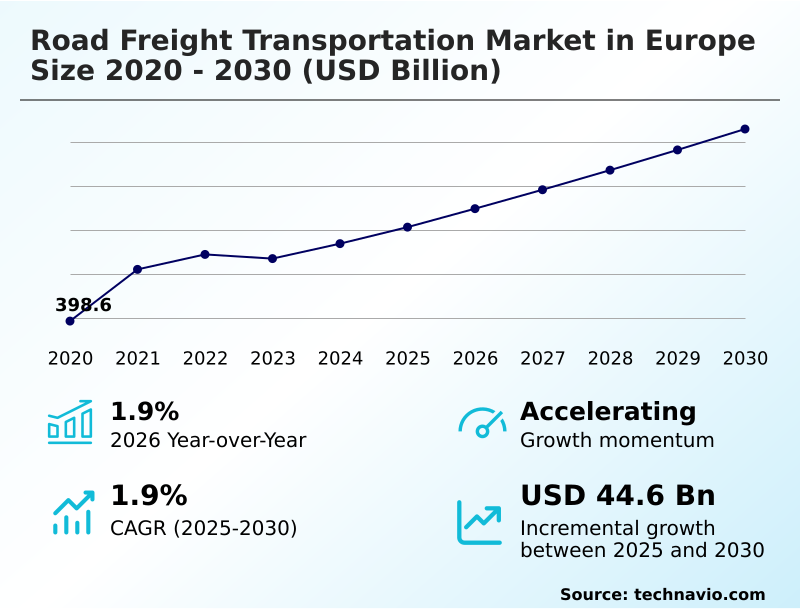
The europe road freight transportation market size is valued to increase by USD 44.6 billion, at a CAGR of 1.9% from 2025 to 2030. Proliferation of e-commerce and last-mile logistics expansion will drive the europe road freight transportation market.
Major Market Trends & Insights
- By Vehicle Type - Medium and heavy commercial vehicle segment was valued at USD 273.6 billion in 2024
- By Product - Food and beverages segment accounted for the largest market revenue share in 2024
Market Size & Forecast
- Market Opportunities: USD 87.3 billion
- Market Future Opportunities: USD 44.6 billion
- CAGR from 2025 to 2030 : 1.9%
Market Summary
- The road freight transportation market in Europe is undergoing a significant transformation driven by digitalization and sustainability mandates. This sector, crucial for continental supply chains, is moving beyond traditional logistics to embrace technologies that enhance efficiency and transparency. Innovations such as digital freight matching and advanced telematics are becoming standard, enabling better route optimization and real-time tracking.
- A key trend is the shift toward green logistics, with companies investing in alternative propulsion systems and circular economy models to meet stringent CO2 emission standards.
- For instance, a large retail consortium may leverage a dedicated contract carriage solution that utilizes a fleet of battery-electric vehicles, managed via a cloud-based platform to ensure end-to-end visibility and compliance with urban low-emission zones. This scenario highlights the industry's pivot toward integrated, data-driven services.
- However, the market also grapples with challenges like a persistent driver shortage and the high capital cost of transitioning to greener fleets, creating a complex but opportunity-rich environment for operators in the road freight transportation market in Europe.
What will be the Size of the Europe Road Freight Transportation Market during the forecast period?
Get Key Insights on Market Forecast (PDF) Get Free Sample
How is the Europe Road Freight Transportation Market Segmented?
The europe road freight transportation industry research report provides comprehensive data (region-wise segment analysis), with forecasts and estimates in "USD billion" for the period 2026-2030, as well as historical data from 2020-2024 for the following segments.
- Vehicle type
- Medium and heavy commercial vehicle
- Light commercial vehicle
- Product
- Food and beverages
- Metals and mining
- Dangerous goods
- Agriculture
- Others
- Service
- Full truckload
- Less-than-truckload
- Express and parcel services
- Dedicated contract carriage
- Intermodal transport
- Geography
- Europe
- Germany
- Spain
- UK
- Europe
By Vehicle Type Insights
The medium and heavy commercial vehicle segment is estimated to witness significant growth during the forecast period.
The road freight transportation market in Europe is segmented by intricate service models and technological integration. Key offerings span from traditional freight to advanced digital solutions, where real-time tracking technologies are standard.
A major focus is on optimizing last-mile logistics, driven by the surge in cross-border e-commerce, which demands robust warehouse management systems and automated sorting technologies. Efficiency is paramount, with digital freight matching platforms aiming for significant empty backhaul reduction.
The evolution towards a more integrated trans-european transport network involves complex intermodal transport solutions and the adoption of alternative fuels like hydrotreated vegetable oil.
This transition incorporates battery-electric vehicles and hydrogen fuel cell technology, alongside streamlined processes like electronic consignment notes to support a seamless flow of goods.
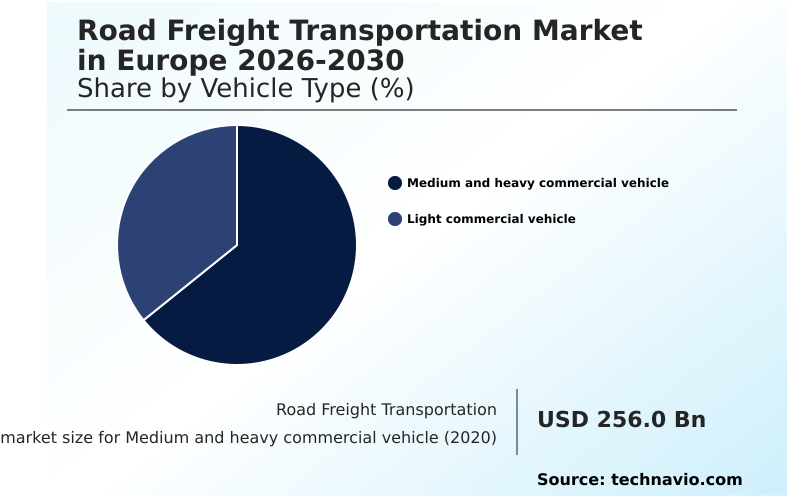
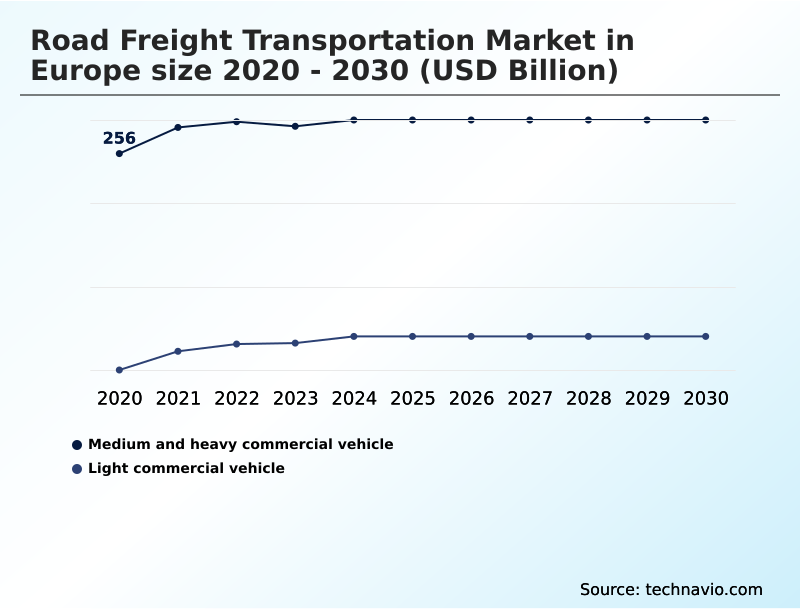
The Medium and heavy commercial vehicle segment was valued at USD 273.6 billion in 2024 and showed a gradual increase during the forecast period.
Market Dynamics
Our researchers analyzed the data with 2025 as the base year, along with the key drivers, trends, and challenges. A holistic analysis of drivers will help companies refine their marketing strategies to gain a competitive advantage.
- Strategic planning in the road freight transportation market in Europe 2026-2030 requires a deep understanding of interconnected challenges and opportunities. The impact of low-emission zones on urban logistics is forcing a re-evaluation of last-mile delivery optimization with micro-fulfillment centers.
- Simultaneously, blockchain applications for supply chain transparency are becoming crucial for compliance with the unified green transit protocol and for enabling the use of electronic consignment notes in cross-border e-commerce. Boardrooms are grappling with strategies for driver shortage mitigation in trucking, where digital twin technology for predictive maintenance in fleets can improve asset utilization and driver satisfaction.
- Investment in hydrogen fuel cell technology infrastructure is a long-term bet, whereas the immediate cost-benefit analysis of hydrotreated vegetable oil is more pressing. Optimizing payload efficiency in heavy-duty vehicles and integrating high-capacity vehicles into the trans-european transport network are key to improving margins. For SMEs, the challenges of green fleet renewals are significant, often leading to market consolidation.
- Circular economy principles in reverse logistics operations and advancements in temperature-controlled transportation for pharmaceuticals open new, high-value service lines. The role of digital freight matching in empty backhaul reduction is now proven, with platforms showing efficiency gains over 20%. Similarly, improving cross-docking operations for less-than-truckload services is a core focus.
- Ultimately, managing risk management in dangerous goods transport logistics and understanding the future of autonomous driving assistance in long-haul freight will separate market leaders from followers, especially as decentralized distribution frameworks for quick-commerce become mainstream.
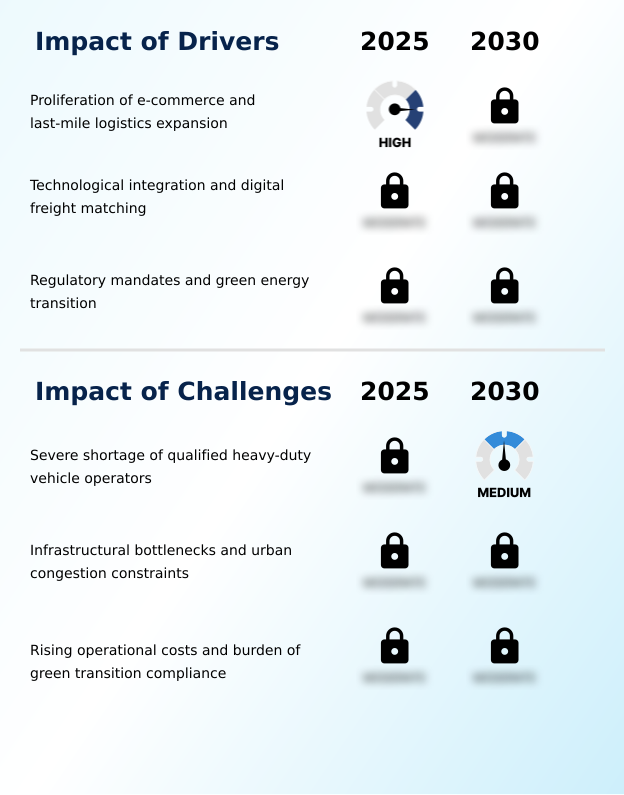
What are the key market drivers leading to the rise in the adoption of Europe Road Freight Transportation Industry?
- The proliferation of e-commerce and the consequent expansion of last-mile logistics networks serve as a primary driver for the road freight transportation market in Europe.
- The market's growth is propelled by powerful digital and commercial drivers. The expansion of cross-border e-commerce is the primary catalyst, creating immense demand for efficient less-than-truckload services and specialized light commercial vehicles to handle last-mile logistics.
- This surge is supported by the deployment of advanced fleet management systems and route optimization technologies, which are critical for navigating complex urban environments.
- Digital freight matching platforms are instrumental in achieving significant empty backhaul reduction, with some platforms improving fleet utilization by up to 15%.
- Furthermore, real-time tracking technologies and electronic consignment notes are streamlining operations across the trans-european transport network, creating more resilient supply chains.
- The integration of autonomous driving assistance and semi-automated loading technologies is also beginning to address persistent infrastructural bottlenecks and enhance overall productivity.
What are the market trends shaping the Europe Road Freight Transportation Industry?
- The proliferation of high-capacity modular vehicle systems represents a key market trend, driven by the need to enhance operational efficiency and reduce the carbon footprint of long-haul logistics.
- Key trends are reshaping the European road freight sector, driven by a dual focus on efficiency and sustainability. The adoption of green propulsion systems is accelerating, with a notable increase in the registration of heavy-duty trucks by over 10% in leading markets, signaling a shift in capital expenditure. The development of high-capacity vehicles is crucial for optimizing full truckload services.
- In parallel, advancements in urban logistics are addressing the demands of just-in-time delivery, supported by micro-fulfillment centers and sophisticated reverse logistics operations. Digitalization is a dominant theme, with digital twin technology and blockchain for supply chain providing unprecedented end-to-end visibility.
- This enables more effective circular economy logistics and improves the functionality of intermodal transshipment hubs through real-time data interchange, essential for a more connected and responsive transport ecosystem.
What challenges does the Europe Road Freight Transportation Industry face during its growth?
- A severe shortage of qualified heavy-duty vehicle operators presents a significant challenge to the road freight industry, impacting operational capacity and future growth.
- Operators face significant structural and financial challenges that temper market growth. The high cost of green fleet renewals, coupled with stringent CO2 emission standards, places considerable pressure on profit margins, particularly for SMEs. The persistent driver shortage, with the average driver age now exceeding 50 in many regions, remains a primary concern, making driver shortage mitigation a top strategic priority.
- Navigating a complex web of regulations, including varying pan-european operating licenses and the implementation of low-emission zones, adds to operational complexity. On the ground, inefficient cross-docking operations and infrastructural bottlenecks hinder the seamless flow of goods, impacting both groupage road logistics and express and parcel services.
- Firms are increasingly turning to dedicated contract carriage and decentralized distribution frameworks to secure capacity and improve operational efficiency gains in this demanding environment.
Exclusive Technavio Analysis on Customer Landscape
The europe road freight transportation market forecasting report includes the adoption lifecycle of the market, covering from the innovator’s stage to the laggard’s stage. It focuses on adoption rates in different regions based on penetration. Furthermore, the europe road freight transportation market report also includes key purchase criteria and drivers of price sensitivity to help companies evaluate and develop their market growth analysis strategies.
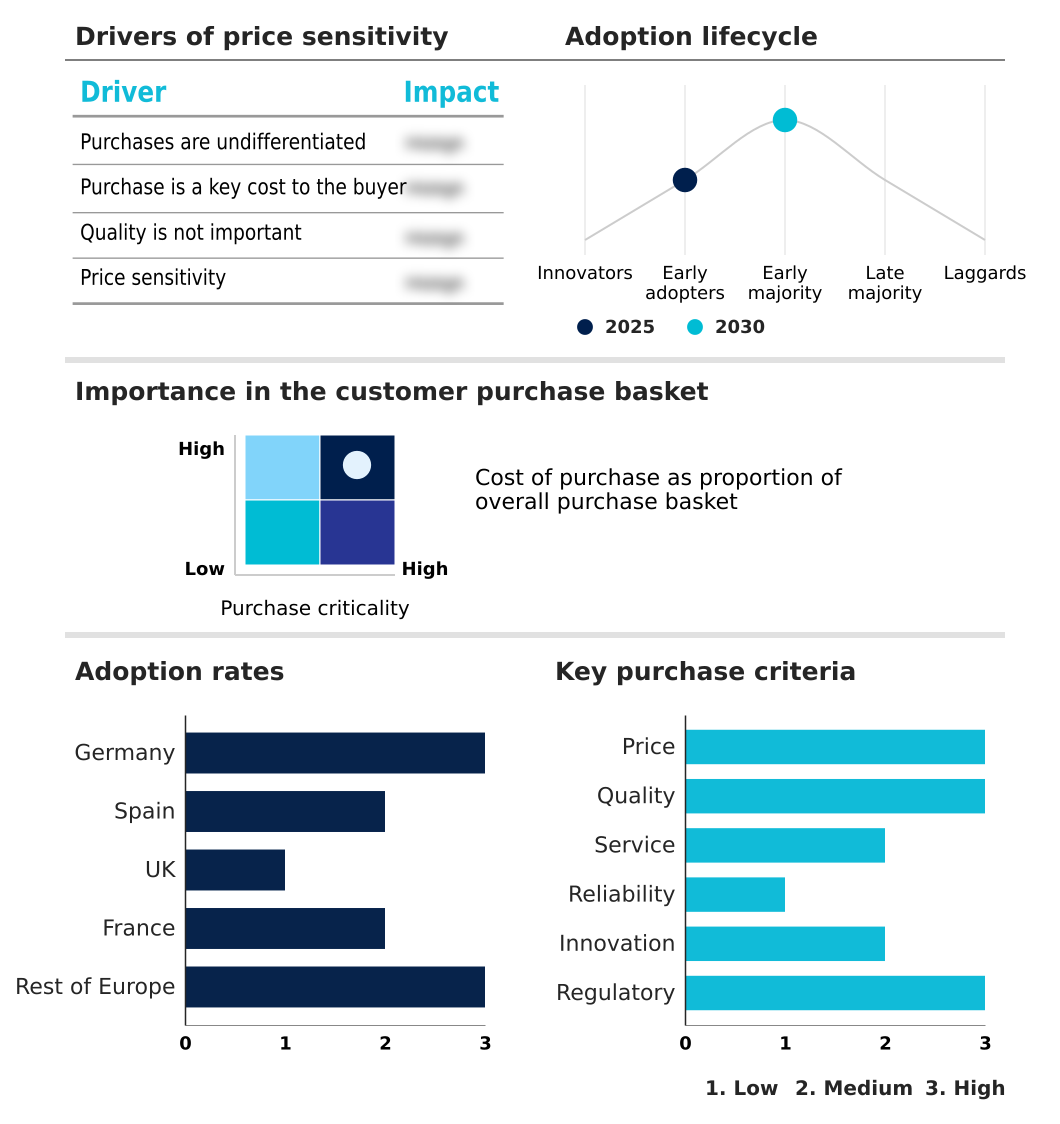
Customer Landscape of Europe Road Freight Transportation Industry
Competitive Landscape
Companies are implementing various strategies, such as strategic alliances, europe road freight transportation market forecast, partnerships, mergers and acquisitions, geographical expansion, and product/service launches, to enhance their presence in the industry.
CEVA Logistics SA - Analyzes integrated road freight services, from full truckload to LTL, to enhance supply chain efficiency and optimize complex transport networks.
The industry research and growth report includes detailed analyses of the competitive landscape of the market and information about key companies, including:
- CEVA Logistics SA
- Dachser SE
- DB Schenker
- DFDS AS
- DHL International GmbH
- DSV AS
- FedEx Corp.
- Fercam Spa
- FM Logistic
- GEODIS
- H.Essers
- Hellmann Worldwide Logistics
- Kuehne Nagel Management AG
- Mainfreight Ltd
- Rhenus SE and Co. KG
- STEF Group
- United Parcel Service Inc.
- Waberers International Plc
- WALTER LEASING GmbH
- XPO Inc.
Qualitative and quantitative analysis of companies has been conducted to help clients understand the wider business environment as well as the strengths and weaknesses of key industry players. Data is qualitatively analyzed to categorize companies as pure play, category-focused, industry-focused, and diversified; it is quantitatively analyzed to categorize companies as dominant, leading, strong, tentative, and weak.
Recent Development and News in Europe road freight transportation market
- In October 2024, DB Schenker announced a strategic partnership with a leading software firm to deploy an AI-driven platform for optimizing cross-border freight matching and reducing empty mileage across its European network.
- In January 2025, Kuehne Nagel Management AG placed a landmark order for 500 battery-electric trucks, one of the largest single orders for heavy-duty EV fleets, to accelerate its transition towards sustainable logistics in key European markets.
- In March 2025, DHL International GmbH completed its acquisition of a specialized last-mile delivery tech startup for approximately USD 200 million, aiming to enhance its urban logistics capabilities and service speed for e-commerce clients.
- In May 2025, The European Commission announced the 'Green Freight Corridors' initiative, allocating EUR 1.5 billion to co-finance the development of a high-power charging and hydrogen refueling network for heavy-duty vehicles along the Trans-European Transport Network.
Dive into Technavio’s robust research methodology, blending expert interviews, extensive data synthesis, and validated models for unparalleled Europe Road Freight Transportation Market insights. See full methodology.
| Market Scope | |
|---|---|
| Page number | 223 |
| Base year | 2025 |
| Historic period | 2020-2024 |
| Forecast period | 2026-2030 |
| Growth momentum & CAGR | Accelerate at a CAGR of 1.9% |
| Market growth 2026-2030 | USD 44.6 billion |
| Market structure | Fragmented |
| YoY growth 2025-2026(%) | 1.9% |
| Key countries | Germany, Spain, UK, France and Rest of Europe |
| Competitive landscape | Leading Companies, Market Positioning of Companies, Competitive Strategies, and Industry Risks |
Research Analyst Overview
- The road freight transportation market in Europe is navigating a complex transition defined by technological adoption and sustainability pressures. The core of this evolution lies in deploying digital freight matching for empty backhaul reduction and integrating real-time tracking technologies for enhanced visibility. As cross-border e-commerce expands, so does the reliance on efficient last-mile logistics and sophisticated warehouse management systems.
- Operationally, the industry is shifting toward intermodal transport solutions and green propulsion systems to meet stringent CO2 emission standards, prompting investment in alternative propulsion systems. This focus on sustainable road freight is evident in the adoption of circular economy logistics and the optimization of urban logistics.
- Fleet operators are leveraging high-capacity vehicles and digital twin technology, complemented by blockchain for supply chain integrity. Service offerings are diversifying from standard full truckload services and less-than-truckload services to specialized temperature-controlled transportation, cold chain logistics, and dangerous goods transport.
- The growth in light commercial vehicles for express and parcel services, with new registrations growing by over 2.3% in some regions, highlights the e-commerce boom. Compliance with the unified green transit protocol is driving changes across groupage road logistics and dedicated contract carriage, pushing for greater supply chain transparency and the use of route optimization technologies.
- Digital freight brokerage, predictive maintenance, and advanced fleet management systems are essential for improving payload efficiency and navigating low-emission zones and carbon-based road tolls.
What are the Key Data Covered in this Europe Road Freight Transportation Market Research and Growth Report?
-
What is the expected growth of the Europe Road Freight Transportation Market between 2026 and 2030?
-
USD 44.6 billion, at a CAGR of 1.9%
-
-
What segmentation does the market report cover?
-
The report is segmented by Vehicle Type (Medium and heavy commercial vehicle, and Light commercial vehicle), Product (Food and beverages, Metals and mining, Dangerous goods, Agriculture, and Others), Service (Full truckload, Less-than-truckload, Express and parcel services, Dedicated contract carriage, and Intermodal transport) and Geography (Europe)
-
-
Which regions are analyzed in the report?
-
Europe
-
-
What are the key growth drivers and market challenges?
-
Proliferation of e-commerce and last-mile logistics expansion, Severe shortage of qualified heavy-duty vehicle operators
-
-
Who are the major players in the Europe Road Freight Transportation Market?
-
CEVA Logistics SA, Dachser SE, DB Schenker, DFDS AS, DHL International GmbH, DSV AS, FedEx Corp., Fercam Spa, FM Logistic, GEODIS, H.Essers, Hellmann Worldwide Logistics, Kuehne Nagel Management AG, Mainfreight Ltd, Rhenus SE and Co. KG, STEF Group, United Parcel Service Inc., Waberers International Plc, WALTER LEASING GmbH and XPO Inc.
-
Market Research Insights
- Market dynamics are increasingly shaped by the adoption of advanced digital and sustainable technologies. The integration of autonomous driving assistance and advanced telematics systems is becoming a key differentiator, with early adopters reporting up to a 15% reduction in fuel consumption.
- The push for resilient supply chains is accelerating the use of decentralized distribution frameworks and micro-fulfillment centers, which improves last-mile delivery optimization. This shift is critical as some urban areas have seen a 25% increase in parcel volumes.
- Furthermore, the development of intermodal transshipment hubs and the use of hydrotreated vegetable oil reflect a strategic pivot, allowing for a more flexible and sustainable multi-modal transport chain while navigating persistent infrastructural bottlenecks.
We can help! Our analysts can customize this europe road freight transportation market research report to meet your requirements.
 RIA -
RIA -