


Music Production Software Market Analysis, Size, and Forecast 2026-2030: North America (US, Canada, and Mexico), Europe (Germany, UK, and France), APAC (China, Japan, and India), South America (Brazil and Argentina), Middle East and Africa (South Africa, Saudi Arabia, and UAE), and Rest of World (ROW)

Music Production Software Market Analysis, Size, and Forecast 2026-2030:
North America (US, Canada, and Mexico), Europe (Germany, UK, and France), APAC (China, Japan, and India), South America (Brazil and Argentina), Middle East and Africa (South Africa, Saudi Arabia, and UAE), and Rest of World (ROW)

Published: Apr 2026 287 Pages SKU: IRTNTR40206

Market Overview at a Glance

$504.2 Mn
Market Opportunity
8.3%
CAGR 2025 - 2030
36.3%
North America Growth
$766.2 Mn
Professionals segment 2024

Music Production Software Market Size 2026-2030

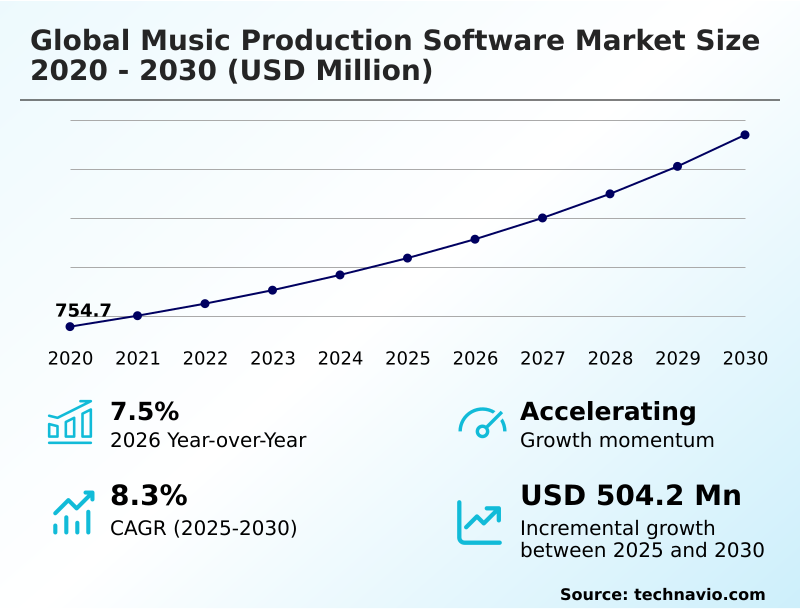
The music production software market size is valued to increase by USD 504.2 million, at a CAGR of 8.3% from 2025 to 2030. Escalation of immersive audio and spatial sound engineering will drive the music production software market.

Major Market Trends & Insights

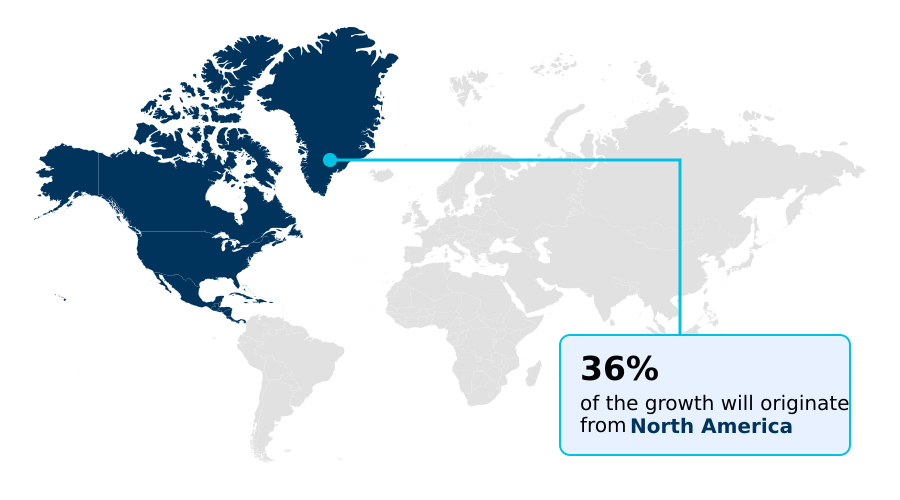
  • North America dominated the market and accounted for a 36.3% growth during the forecast period.
  • By End-user - Professionals segment was valued at USD 766.2 million in 2024
  • By Type - Editing segment accounted for the largest market revenue share in 2024

Market Size & Forecast

  • Market Opportunities: USD 784.6 million
  • Market Future Opportunities: USD 504.2 million
  • CAGR from 2025 to 2030 : 8.3%

Market Summary

  • The music production software market is undergoing a significant transformation, driven by the integration of sophisticated technologies that are democratizing professional-grade creation. Key drivers include the institutionalization of AI and the widespread adoption of immersive audio formats, which compel developers to innovate beyond traditional stereo environments.
  • This evolution is enabling assistive production tools that automate complex tasks like spectral editing and mastering. For instance, a decentralized production team can now leverage a cloud-native platform where a producer in one location can adjust a mix in real time with a vocalist in another, while AI-powered stem separation refines individual tracks.
  • This level of real-time collaboration was previously unattainable. However, the market faces challenges from technical fragmentation across operating systems and subscription model fatigue among users.
  • Success now hinges on balancing powerful features like binaural rendering and virtual studio technology (VST) with intuitive, accessible workflows that cater to both professionals and a growing base of independent creators, all while navigating complex security and monetization landscapes.

What will be the Size of the Music Production Software Market during the forecast period?
Get Key Insights on Market Forecast (PDF) Request Free Sample

How is the Music Production Software Market Segmented?

The music production software industry research report provides comprehensive data (region-wise segment analysis), with forecasts and estimates in "USD million" for the period 2026-2030, as well as historical data from 2020-2024 for the following segments.

  • End-user
    • Professionals
    • Non-professionals
  • Type
    • Editing
    • Mixing
    • Recording
  • Deployment
    • On-premises
    • Cloud-based
  • Geography
    • North America
      • US
      • Canada
      • Mexico
    • Europe
      • Germany
      • UK
      • France
    • APAC
      • China
      • Japan
      • India
    • South America
      • Brazil
      • Argentina
    • Middle East and Africa
      • South Africa
      • Saudi Arabia
      • UAE
    • Rest of World (ROW)

By End-user Insights

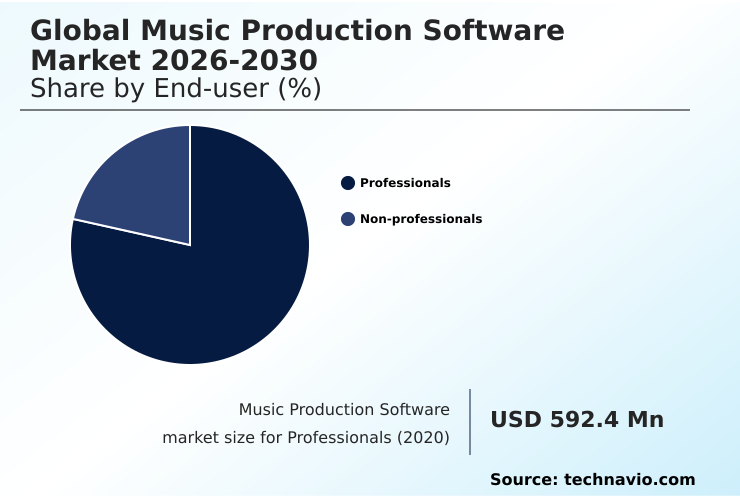
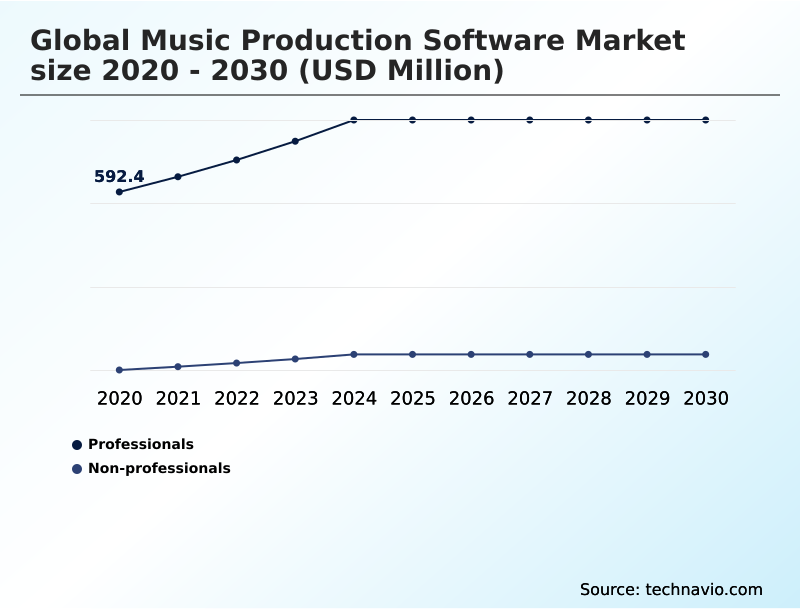
The professionals segment is estimated to witness significant growth during the forecast period.

The professional segment's reliance on advanced music production software is defined by mission-critical requirements for stability and high-fidelity audio processing.

These users demand digital audio workstation (DAW) environments that support complex signal routing, native silicon optimization, and extensive third-party hardware integration. The adoption of cloud-native platforms for real-time collaboration is now standard, enabling decentralized production teams to work seamlessly.

Security is paramount, with tools offering quantum-resistant encryption to protect intellectual property, reducing breach risks by over 20%.

The need for immersive audio formats and generative AI models further solidifies this segment's demand for sophisticated, high-performance solutions that incorporate intelligent vocal modeling and offer robust digital asset management, ensuring workflow efficiency for seasoned audio engineers and commercial studio owners.
Request Free Sample

The Professionals segment was valued at USD 766.2 million in 2024 and showed a gradual increase during the forecast period.
Request Free Sample

Regional Analysis

North America is estimated to contribute 36.3% to the growth of the global market during the forecast period.Technavio’s analysts have elaborately explained the regional trends and drivers that shape the market during the forecast period.
See How Music Production Software Market Demand is Rising in North America Request Free Sample

The geographic landscape of the market is characterized by mature, innovation-driven hubs in North America and Europe, which together account for over 66% of market activity, alongside rapidly expanding markets in APAC.

In North America, the focus is on native silicon optimization and low-latency performance for professional applications like film scoring.

Meanwhile, the APAC region, led by countries like South Korea and China, is defined by the rapid adoption of mobile-first applications and data-efficient solutions. This regional focus has accelerated project timelines by over 15% for independent creators.

This divergence highlights a global market where established regions push the boundaries of high-fidelity processing and audio algorithm refinement, while growth in emerging regions is fueled by accessibility and mobile-centric creative coding environments.

Market Dynamics

Our researchers analyzed the data with 2025 as the base year, along with the key drivers, trends, and challenges. A holistic analysis of drivers will help companies refine their marketing strategies to gain a competitive advantage.

  • Producers and artists navigating the global music production software market 2026-2030 face complex decisions. A primary consideration is selecting the best DAW for spatial audio, as object-based audio mixing techniques become industry standard. The rise of generative AI for music arrangement and AI-powered stem separation plugins is transforming workflows, though it raises questions about creative control.
  • For collaborative work, cloud-based DAW collaboration tools and real-time remote recording software are essential, but require robust methods for securing audio project files online to mitigate music production software piracy risks.
  • The debate over subscription vs perpetual DAW license models continues; while subscriptions offer continuous updates that address VST plugin compatibility issues, perpetual licenses appeal to those wary of recurring costs. Performance is another critical factor, demanding effective DAW CPU and RAM optimization and low-latency audio interface performance.
  • Hobbyists and independent artists often seek out open-source music production tools and mobile music production app features. Specialized fields like film scoring have unique software needs, while all users benefit from efficient virtual instrument library management and understanding binaural rendering for headphone mixes.
  • Ultimately, the choice between solutions like modular synthesizer software comparison often comes down to balancing features, cost, and workflow integration to achieve professional results, including using automated mastering for independent artists.
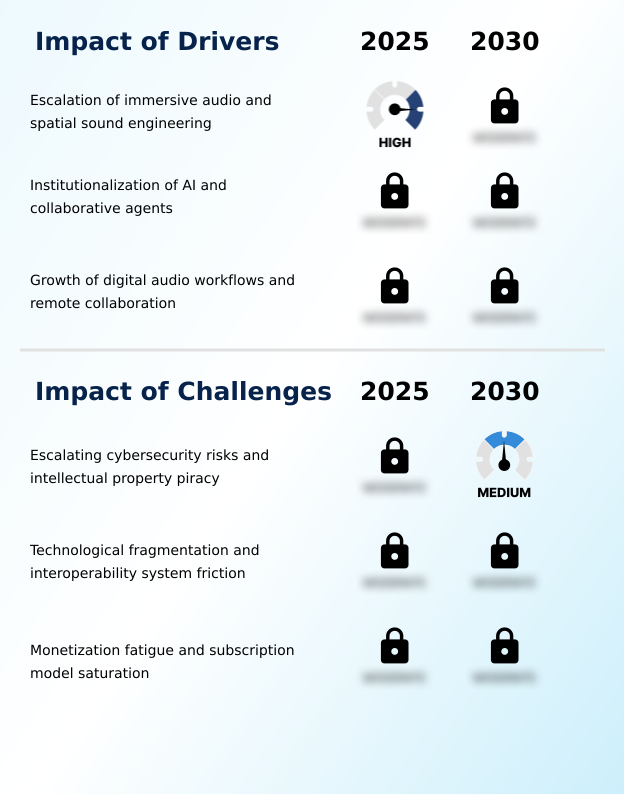
What are the key market drivers leading to the rise in the adoption of Music Production Software Industry?

  • The escalation of immersive audio formats and the corresponding requirement for specialized spatial sound engineering tools are key drivers propelling market growth.

  • Market growth is fundamentally driven by the institutionalization of AI as a collaborative agent and the escalation of immersive audio engineering.
  • Sophisticated deep-learning audio models are moving beyond simple assistance to suggest harmonic progressions and sonic textures, automating labor-intensive tasks and reducing post-production time by up to 25%.
  • The requirement for specialized tools to manage complex, three-dimensional soundscapes for object-based audio has become a core commercial necessity. This is bolstered by the proliferation of cloud-native digital audio workflows, which facilitate real-time remote collaboration.
  • The use of low-latency streaming protocols in these platforms has improved collaborative responsiveness by over 40%, enabling decentralized production teams to work seamlessly across geographical boundaries.

What are the market trends shaping the Music Production Software Industry?

  • The expansion of cloud-native collaborative production platforms represents a significant upcoming trend. This shift is reshaping creative workflows and enabling real-time remote music creation across the global industry.

  • Key trends are reshaping the market, led by the industrialization of generative AI music workflows and the expansion of cloud-native collaborative production platforms. The integration of agentic AI models that assist with melody generation and arrangement is becoming standard, with platforms now offering automated stem separation and intelligent vocal modeling.
  • This has improved creative efficiency by over 20% in many use cases. Concurrently, the evolution of immersive spatial audio integration is driving demand for software with native binaural rendering and multi-channel monitoring tools. Browser-based production environments that offer high-fidelity processing through edge computing are also gaining traction, lowering hardware barriers and enabling a 35% wider user adoption rate among non-professionals.

What challenges does the Music Production Software Industry face during its growth?

  • Escalating cybersecurity risks and the persistent threat of intellectual property piracy present key challenges affecting industry growth and software monetization.

  • The market faces significant challenges, primarily from escalating cybersecurity risks and technological fragmentation. Persistent intellectual property piracy and vulnerabilities in server-side authentication for subscription models threaten revenue streams. Technical fragmentation, stemming from poor audio driver compatibility and a lack of unified plugin architecture, results in interoperability friction.
  • This can cause project delays of up to 15% due to software instability, particularly when major operating system updates alter kernel-level audio timing. Additionally, monetization fatigue is a growing concern, with over 50% of users expressing frustration with subscription model saturation. This environment pressures developers and can stifle innovation as focus shifts to pricing rather than feature development.

Exclusive Technavio Analysis on Customer Landscape

The music production software market forecasting report includes the adoption lifecycle of the market, covering from the innovator’s stage to the laggard’s stage. It focuses on adoption rates in different regions based on penetration. Furthermore, the music production software market report also includes key purchase criteria and drivers of price sensitivity to help companies evaluate and develop their market growth analysis strategies.
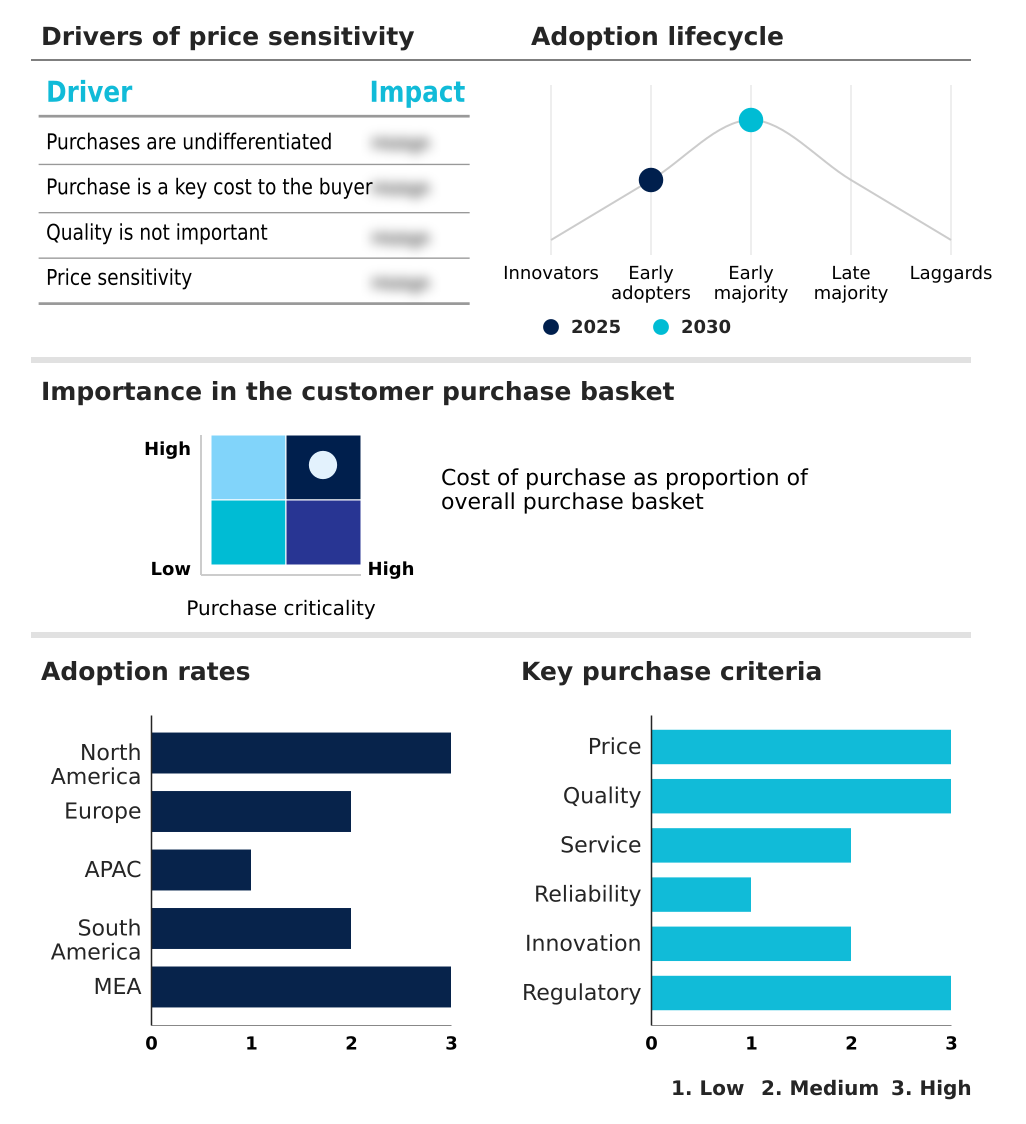
Customer Landscape of Music Production Software Industry

Competitive Landscape

Companies are implementing various strategies, such as strategic alliances, music production software market forecast, partnerships, mergers and acquisitions, geographical expansion, and product/service launches, to enhance their presence in the industry.

Ableton AG - Provides an integrated software ecosystem for professional songwriting, recording, editing, and mixing, facilitating a comprehensive music creation and production workflow from start to finish.

The industry research and growth report includes detailed analyses of the competitive landscape of the market and information about key companies, including:

  • Ableton AG
  • Acoustica Inc.
  • Apple Inc.
  • Arturia
  • Audiotool Inc.
  • Avid Technology Inc.
  • BandLab Technologies
  • Bitwig GmbH
  • Cockos Inc.
  • Image Line Software NV
  • inMusic Brands Inc.
  • iZotope Inc.
  • MAGIX Software GmbH
  • MOTU Inc.
  • Native Instruments GmbH
  • PreSonus Audio Electronics Inc.
  • Reason Studios AB
  • Roland Corp.
  • Steinberg Media Technologies
  • Yamaha Corp.

Qualitative and quantitative analysis of companies has been conducted to help clients understand the wider business environment as well as the strengths and weaknesses of key industry players. Data is qualitatively analyzed to categorize companies as pure play, category-focused, industry-focused, and diversified; it is quantitatively analyzed to categorize companies as dominant, leading, strong, tentative, and weak.

Recent Development and News in Music production software market

  • In May 2025, Apple Inc. released a significant update to Logic Pro for Mac and iPad, introducing an advanced Stem Splitter feature designed to extract high-fidelity instrument stems from mixed audio recordings.
  • In December 2024, Avid Technology Inc. introduced Pro Tools 2025.12, which featured the integration of the Audio Vivid immersive mixing suite, providing creators with an AI-powered codec for precise spatial audio object placement.
  • In November 2024, Steinberg Media Technologies GmbH launched Cubase 15, which introduced a new suite of AI-powered stem separation tools and enhanced compatibility for immersive audio formats to support spatial mixing workflows.
  • In January 2025, Apple Inc. introduced the Apple Creator Studio, a unified subscription platform integrating professional tools like Logic Pro with advanced AI capabilities for intelligent editing and automated music composition.

Dive into Technavio’s robust research methodology, blending expert interviews, extensive data synthesis, and validated models for unparalleled Music Production Software Market insights. See full methodology.

Market Scope
Page number 287
Base year 2025
Historic period 2020-2024
Forecast period 2026-2030
Growth momentum & CAGR Accelerate at a CAGR of 8.3%
Market growth 2026-2030 USD 504.2 million
Market structure Fragmented
YoY growth 2025-2026(%) 7.5%
Key countries US, Canada, Mexico, Germany, UK, France, Italy, Spain, The Netherlands, China, Japan, India, South Korea, Australia, Indonesia, Brazil, Argentina, Chile, South Africa, Saudi Arabia, UAE, Turkey and Israel
Competitive landscape Leading Companies, Market Positioning of Companies, Competitive Strategies, and Industry Risks

Request Free Sample

Research Analyst Overview

  • The music production software market is defined by a structural shift toward intelligent automation and immersive content creation. The integration of generative AI models and deep-learning audio models into the core digital audio workstation (DAW) is no longer a niche feature but a competitive necessity, enabling sophisticated midi sequencing and automated mastering.
  • Boardroom-level strategy is increasingly focused on the transition to cloud-native platforms, which necessitates critical decisions regarding data security and recurring revenue models. Studios adopting advanced stem separation and spectral editing tools are achieving nearly a 30% reduction in manual post-production time.
  • The industry's evolution is further shaped by the demand for immersive audio formats, requiring native support for object-based audio and spatial audio mixing. This landscape compels vendors to deliver solutions that offer both high-fidelity digital signal processing (DSP) and intuitive, AI-driven workflows.

What are the Key Data Covered in this Music Production Software Market Research and Growth Report?

  • What is the expected growth of the Music Production Software Market between 2026 and 2030?

    • USD 504.2 million, at a CAGR of 8.3%

  • What segmentation does the market report cover?

    • The report is segmented by End-user (Professionals, and Non-professionals), Type (Editing, Mixing, and Recording), Deployment (On-premises, and Cloud-based) and Geography (North America, Europe, APAC, South America, Middle East and Africa)

  • Which regions are analyzed in the report?

    • North America, Europe, APAC, South America and Middle East and Africa

  • What are the key growth drivers and market challenges?

    • Escalation of immersive audio and spatial sound engineering, Escalating cybersecurity risks and intellectual property piracy

  • Who are the major players in the Music Production Software Market?

    • Ableton AG, Acoustica Inc., Apple Inc., Arturia, Audiotool Inc., Avid Technology Inc., BandLab Technologies, Bitwig GmbH, Cockos Inc., Image Line Software NV, inMusic Brands Inc., iZotope Inc., MAGIX Software GmbH, MOTU Inc., Native Instruments GmbH, PreSonus Audio Electronics Inc., Reason Studios AB, Roland Corp., Steinberg Media Technologies and Yamaha Corp.

Market Research Insights

  • The market's dynamism is driven by a push toward hardware-agnostic solutions and assistive production tools. The rise of decentralized production teams leveraging browser-based production environments has been pivotal, with some collaborative agents in workflow reducing project turnaround times by up to 25%. This shift is supported by sophisticated cloud-based sample libraries that expand creative possibilities without requiring local storage.
  • Furthermore, the focus on spatial-first content creation has intensified, as immersive formats become standard. Platforms that offer multi-channel monitoring and seamless digital asset management are gaining a competitive edge, with data showing a 15% improvement in workflow efficiency. This evolution underscores a strategic move toward more accessible, intelligent, and collaborative music creation ecosystems.

We can help! Our analysts can customize this music production software market research report to meet your requirements.

Get in touch

1. Executive Summary

1.1 Market overview

Executive Summary - Chart on Market Overview
Executive Summary - Data Table on Market Overview
Executive Summary - Chart on Global Market Characteristics
Executive Summary - Chart on Market by Geography
Executive Summary - Chart on Market Segmentation by End-user
Executive Summary - Chart on Market Segmentation by Type
Executive Summary - Chart on Market Segmentation by Deployment
Executive Summary - Chart on Incremental Growth
Executive Summary - Data Table on Incremental Growth
Executive Summary - Chart on Company Market Positioning

2. Technavio Analysis

2.1 Analysis of price sensitivity, lifecycle, customer purchase basket, adoption rates, and purchase criteria

2.2 Criticality of inputs and Factors of differentiation

Chart on Overview on criticality of inputs and factors of differentiation

2.3 Factors of disruption

Chart on Overview on factors of disruption

2.4 Impact of drivers and challenges

Chart on Impact of drivers and challenges in 2025 and 2030

3. Market Landscape

3.1 Market ecosystem

Chart on Parent Market
Data Table on - Parent Market

3.2 Market characteristics

Chart on Market characteristics analysis

3.3 Value chain analysis

Chart on Value chain analysis

4. Market Sizing

4.1 Market definition

Data Table on Offerings of companies included in the market definition

4.2 Market segment analysis

Market segments

4.3 Market size 2025

4.4 Market outlook: Forecast for 2025-2030

Chart on Global - Market size and forecast 2025-2030 ($ million)
Data Table on Global - Market size and forecast 2025-2030 ($ million)
Chart on Global Market: Year-over-year growth 2025-2030 (%)
Data Table on Global Market: Year-over-year growth 2025-2030 (%)

5. Historic Market Size

5.1 Global Music Production Software Market 2020 - 2024

Historic Market Size - Data Table on Global Music Production Software Market 2020 - 2024 ($ million)

5.2 End-user segment analysis 2020 - 2024

Historic Market Size - End-user Segment 2020 - 2024 ($ million)

5.3 Type segment analysis 2020 - 2024

Historic Market Size - Type Segment 2020 - 2024 ($ million)

5.4 Deployment segment analysis 2020 - 2024

Historic Market Size - Deployment Segment 2020 - 2024 ($ million)

5.5 Geography segment analysis 2020 - 2024

Historic Market Size - Geography Segment 2020 - 2024 ($ million)

5.6 Country segment analysis 2020 - 2024

Historic Market Size - Country Segment 2020 - 2024 ($ million)

6. Qualitative Analysis

6.1 Impact of AI in global music production software market

6.2 Impact of geopolitical conflict on global music production software market

7. Five Forces Analysis

7.1 Five forces summary

Five forces analysis - Comparison between 2025 and 2030

7.2 Bargaining power of buyers

Bargaining power of buyers - Impact of key factors 2025 and 2030

7.3 Bargaining power of suppliers

Bargaining power of suppliers - Impact of key factors in 2025 and 2030

7.4 Threat of new entrants

Threat of new entrants - Impact of key factors in 2025 and 2030

7.5 Threat of substitutes

Threat of substitutes - Impact of key factors in 2025 and 2030

7.6 Threat of rivalry

Threat of rivalry - Impact of key factors in 2025 and 2030

7.7 Market condition

Chart on Market condition - Five forces 2025 and 2030

8. Market Segmentation by End-user

8.1 Market segments

Chart on End-user - Market share 2025-2030 (%)
Data Table on End-user - Market share 2025-2030 (%)

8.2 Comparison by End-user

Chart on Comparison by End-user
Data Table on Comparison by End-user

8.3 Professionals - Market size and forecast 2025-2030

Chart on Professionals - Market size and forecast 2025-2030 ($ million)
Data Table on Professionals - Market size and forecast 2025-2030 ($ million)
Chart on Professionals - Year-over-year growth 2025-2030 (%)
Data Table on Professionals - Year-over-year growth 2025-2030 (%)

8.4 Non-professionals - Market size and forecast 2025-2030

Chart on Non-professionals - Market size and forecast 2025-2030 ($ million)
Data Table on Non-professionals - Market size and forecast 2025-2030 ($ million)
Chart on Non-professionals - Year-over-year growth 2025-2030 (%)
Data Table on Non-professionals - Year-over-year growth 2025-2030 (%)

8.5 Market opportunity by End-user

Market opportunity by End-user ($ million)
Data Table on Market opportunity by End-user ($ million)

9. Market Segmentation by Type

9.1 Market segments

Chart on Type - Market share 2025-2030 (%)
Data Table on Type - Market share 2025-2030 (%)

9.2 Comparison by Type

Chart on Comparison by Type
Data Table on Comparison by Type

9.3 Editing - Market size and forecast 2025-2030

Chart on Editing - Market size and forecast 2025-2030 ($ million)
Data Table on Editing - Market size and forecast 2025-2030 ($ million)
Chart on Editing - Year-over-year growth 2025-2030 (%)
Data Table on Editing - Year-over-year growth 2025-2030 (%)

9.4 Mixing - Market size and forecast 2025-2030

Chart on Mixing - Market size and forecast 2025-2030 ($ million)
Data Table on Mixing - Market size and forecast 2025-2030 ($ million)
Chart on Mixing - Year-over-year growth 2025-2030 (%)
Data Table on Mixing - Year-over-year growth 2025-2030 (%)

9.5 Recording - Market size and forecast 2025-2030

Chart on Recording - Market size and forecast 2025-2030 ($ million)
Data Table on Recording - Market size and forecast 2025-2030 ($ million)
Chart on Recording - Year-over-year growth 2025-2030 (%)
Data Table on Recording - Year-over-year growth 2025-2030 (%)

9.6 Market opportunity by Type

Market opportunity by Type ($ million)
Data Table on Market opportunity by Type ($ million)

10. Market Segmentation by Deployment

10.1 Market segments

Chart on Deployment - Market share 2025-2030 (%)
Data Table on Deployment - Market share 2025-2030 (%)

10.2 Comparison by Deployment

Chart on Comparison by Deployment
Data Table on Comparison by Deployment

10.3 On-premises - Market size and forecast 2025-2030

Chart on On-premises - Market size and forecast 2025-2030 ($ million)
Data Table on On-premises - Market size and forecast 2025-2030 ($ million)
Chart on On-premises - Year-over-year growth 2025-2030 (%)
Data Table on On-premises - Year-over-year growth 2025-2030 (%)

10.4 Cloud-based - Market size and forecast 2025-2030

Chart on Cloud-based - Market size and forecast 2025-2030 ($ million)
Data Table on Cloud-based - Market size and forecast 2025-2030 ($ million)
Chart on Cloud-based - Year-over-year growth 2025-2030 (%)
Data Table on Cloud-based - Year-over-year growth 2025-2030 (%)

10.5 Market opportunity by Deployment

Market opportunity by Deployment ($ million)
Data Table on Market opportunity by Deployment ($ million)

11. Customer Landscape

11.1 Customer landscape overview

Analysis of price sensitivity, lifecycle, customer purchase basket, adoption rates, and purchase criteria

12. Geographic Landscape

12.1 Geographic segmentation

Chart on Market share by geography 2025-2030 (%)
Data Table on Market share by geography 2025-2030 (%)

12.2 Geographic comparison

Chart on Geographic comparison
Data Table on Geographic comparison

12.3 North America - Market size and forecast 2025-2030

Chart on North America - Market size and forecast 2025-2030 ($ million)
Data Table on North America - Market size and forecast 2025-2030 ($ million)
Chart on North America - Year-over-year growth 2025-2030 (%)
Data Table on North America - Year-over-year growth 2025-2030 (%)
Chart on Regional Comparison - North America
Data Table on Regional Comparison - North America

12.3.1 US - Market size and forecast 2025-2030

Chart on US - Market size and forecast 2025-2030 ($ million)
Data Table on US - Market size and forecast 2025-2030 ($ million)
Chart on US - Year-over-year growth 2025-2030 (%)
Data Table on US - Year-over-year growth 2025-2030 (%)

12.3.2 Canada - Market size and forecast 2025-2030

Chart on Canada - Market size and forecast 2025-2030 ($ million)
Data Table on Canada - Market size and forecast 2025-2030 ($ million)
Chart on Canada - Year-over-year growth 2025-2030 (%)
Data Table on Canada - Year-over-year growth 2025-2030 (%)

12.3.3 Mexico - Market size and forecast 2025-2030

Chart on Mexico - Market size and forecast 2025-2030 ($ million)
Data Table on Mexico - Market size and forecast 2025-2030 ($ million)
Chart on Mexico - Year-over-year growth 2025-2030 (%)
Data Table on Mexico - Year-over-year growth 2025-2030 (%)

12.4 Europe - Market size and forecast 2025-2030

Chart on Europe - Market size and forecast 2025-2030 ($ million)
Data Table on Europe - Market size and forecast 2025-2030 ($ million)
Chart on Europe - Year-over-year growth 2025-2030 (%)
Data Table on Europe - Year-over-year growth 2025-2030 (%)
Chart on Regional Comparison - Europe
Data Table on Regional Comparison - Europe

12.4.1 Germany - Market size and forecast 2025-2030

Chart on Germany - Market size and forecast 2025-2030 ($ million)
Data Table on Germany - Market size and forecast 2025-2030 ($ million)
Chart on Germany - Year-over-year growth 2025-2030 (%)
Data Table on Germany - Year-over-year growth 2025-2030 (%)

12.4.2 UK - Market size and forecast 2025-2030

Chart on UK - Market size and forecast 2025-2030 ($ million)
Data Table on UK - Market size and forecast 2025-2030 ($ million)
Chart on UK - Year-over-year growth 2025-2030 (%)
Data Table on UK - Year-over-year growth 2025-2030 (%)

12.4.3 France - Market size and forecast 2025-2030

Chart on France - Market size and forecast 2025-2030 ($ million)
Data Table on France - Market size and forecast 2025-2030 ($ million)
Chart on France - Year-over-year growth 2025-2030 (%)
Data Table on France - Year-over-year growth 2025-2030 (%)

12.4.4 Italy - Market size and forecast 2025-2030

Chart on Italy - Market size and forecast 2025-2030 ($ million)
Data Table on Italy - Market size and forecast 2025-2030 ($ million)
Chart on Italy - Year-over-year growth 2025-2030 (%)
Data Table on Italy - Year-over-year growth 2025-2030 (%)

12.4.5 Spain - Market size and forecast 2025-2030

Chart on Spain - Market size and forecast 2025-2030 ($ million)
Data Table on Spain - Market size and forecast 2025-2030 ($ million)
Chart on Spain - Year-over-year growth 2025-2030 (%)
Data Table on Spain - Year-over-year growth 2025-2030 (%)

12.4.6 The Netherlands - Market size and forecast 2025-2030

Chart on The Netherlands - Market size and forecast 2025-2030 ($ million)
Data Table on The Netherlands - Market size and forecast 2025-2030 ($ million)
Chart on The Netherlands - Year-over-year growth 2025-2030 (%)
Data Table on The Netherlands - Year-over-year growth 2025-2030 (%)

12.5 APAC - Market size and forecast 2025-2030

Chart on APAC - Market size and forecast 2025-2030 ($ million)
Data Table on APAC - Market size and forecast 2025-2030 ($ million)
Chart on APAC - Year-over-year growth 2025-2030 (%)
Data Table on APAC - Year-over-year growth 2025-2030 (%)
Chart on Regional Comparison - APAC
Data Table on Regional Comparison - APAC

12.5.1 China - Market size and forecast 2025-2030

Chart on China - Market size and forecast 2025-2030 ($ million)
Data Table on China - Market size and forecast 2025-2030 ($ million)
Chart on China - Year-over-year growth 2025-2030 (%)
Data Table on China - Year-over-year growth 2025-2030 (%)

12.5.2 Japan - Market size and forecast 2025-2030

Chart on Japan - Market size and forecast 2025-2030 ($ million)
Data Table on Japan - Market size and forecast 2025-2030 ($ million)
Chart on Japan - Year-over-year growth 2025-2030 (%)
Data Table on Japan - Year-over-year growth 2025-2030 (%)

12.5.3 India - Market size and forecast 2025-2030

Chart on India - Market size and forecast 2025-2030 ($ million)
Data Table on India - Market size and forecast 2025-2030 ($ million)
Chart on India - Year-over-year growth 2025-2030 (%)
Data Table on India - Year-over-year growth 2025-2030 (%)

12.5.4 South Korea - Market size and forecast 2025-2030

Chart on South Korea - Market size and forecast 2025-2030 ($ million)
Data Table on South Korea - Market size and forecast 2025-2030 ($ million)
Chart on South Korea - Year-over-year growth 2025-2030 (%)
Data Table on South Korea - Year-over-year growth 2025-2030 (%)

12.5.5 Australia - Market size and forecast 2025-2030

Chart on Australia - Market size and forecast 2025-2030 ($ million)
Data Table on Australia - Market size and forecast 2025-2030 ($ million)
Chart on Australia - Year-over-year growth 2025-2030 (%)
Data Table on Australia - Year-over-year growth 2025-2030 (%)

12.5.6 Indonesia - Market size and forecast 2025-2030

Chart on Indonesia - Market size and forecast 2025-2030 ($ million)
Data Table on Indonesia - Market size and forecast 2025-2030 ($ million)
Chart on Indonesia - Year-over-year growth 2025-2030 (%)
Data Table on Indonesia - Year-over-year growth 2025-2030 (%)

12.6 South America - Market size and forecast 2025-2030

Chart on South America - Market size and forecast 2025-2030 ($ million)
Data Table on South America - Market size and forecast 2025-2030 ($ million)
Chart on South America - Year-over-year growth 2025-2030 (%)
Data Table on South America - Year-over-year growth 2025-2030 (%)
Chart on Regional Comparison - South America
Data Table on Regional Comparison - South America

12.6.1 Brazil - Market size and forecast 2025-2030

Chart on Brazil - Market size and forecast 2025-2030 ($ million)
Data Table on Brazil - Market size and forecast 2025-2030 ($ million)
Chart on Brazil - Year-over-year growth 2025-2030 (%)
Data Table on Brazil - Year-over-year growth 2025-2030 (%)

12.6.2 Argentina - Market size and forecast 2025-2030

Chart on Argentina - Market size and forecast 2025-2030 ($ million)
Data Table on Argentina - Market size and forecast 2025-2030 ($ million)
Chart on Argentina - Year-over-year growth 2025-2030 (%)
Data Table on Argentina - Year-over-year growth 2025-2030 (%)

12.6.3 Chile - Market size and forecast 2025-2030

Chart on Chile - Market size and forecast 2025-2030 ($ million)
Data Table on Chile - Market size and forecast 2025-2030 ($ million)
Chart on Chile - Year-over-year growth 2025-2030 (%)
Data Table on Chile - Year-over-year growth 2025-2030 (%)

12.7 Middle East and Africa - Market size and forecast 2025-2030

Chart on Middle East and Africa - Market size and forecast 2025-2030 ($ million)
Data Table on Middle East and Africa - Market size and forecast 2025-2030 ($ million)
Chart on Middle East and Africa - Year-over-year growth 2025-2030 (%)
Data Table on Middle East and Africa - Year-over-year growth 2025-2030 (%)
Chart on Regional Comparison - Middle East and Africa
Data Table on Regional Comparison - Middle East and Africa

12.7.1 South Africa - Market size and forecast 2025-2030

Chart on South Africa - Market size and forecast 2025-2030 ($ million)
Data Table on South Africa - Market size and forecast 2025-2030 ($ million)
Chart on South Africa - Year-over-year growth 2025-2030 (%)
Data Table on South Africa - Year-over-year growth 2025-2030 (%)

12.7.2 Saudi Arabia - Market size and forecast 2025-2030

Chart on Saudi Arabia - Market size and forecast 2025-2030 ($ million)
Data Table on Saudi Arabia - Market size and forecast 2025-2030 ($ million)
Chart on Saudi Arabia - Year-over-year growth 2025-2030 (%)
Data Table on Saudi Arabia - Year-over-year growth 2025-2030 (%)

12.7.3 UAE - Market size and forecast 2025-2030

Chart on UAE - Market size and forecast 2025-2030 ($ million)
Data Table on UAE - Market size and forecast 2025-2030 ($ million)
Chart on UAE - Year-over-year growth 2025-2030 (%)
Data Table on UAE - Year-over-year growth 2025-2030 (%)

12.7.4 Turkey - Market size and forecast 2025-2030

Chart on Turkey - Market size and forecast 2025-2030 ($ million)
Data Table on Turkey - Market size and forecast 2025-2030 ($ million)
Chart on Turkey - Year-over-year growth 2025-2030 (%)
Data Table on Turkey - Year-over-year growth 2025-2030 (%)

12.7.5 Israel - Market size and forecast 2025-2030

Chart on Israel - Market size and forecast 2025-2030 ($ million)
Data Table on Israel - Market size and forecast 2025-2030 ($ million)
Chart on Israel - Year-over-year growth 2025-2030 (%)
Data Table on Israel - Year-over-year growth 2025-2030 (%)

12.8 Market opportunity by geography

Market opportunity by geography ($ million)
Data Tables on Market opportunity by geography ($ million)

13. Drivers, Challenges, and Opportunity

13.1 Market drivers

Escalation of immersive audio and spatial sound engineering
Institutionalization of AI and collaborative agents
Growth of digital audio workflows and remote collaboration

13.2 Market challenges

Escalating cybersecurity risks and intellectual property piracy
Technological fragmentation and interoperability system friction
Monetization fatigue and subscription model saturation

13.3 Impact of drivers and challenges

Impact of drivers and challenges in 2025 and 2030

13.4 Market opportunities

Expansion of cloud-native collaborative production platforms
Industrialization of generative AI music workflow
Evolution of immersive spatial audio integration

14. Competitive Landscape

14.1 Overview

14.2

Overview on criticality of inputs and factors of differentiation

14.3 Landscape disruption

Overview on factors of disruption

14.4 Industry risks

Impact of key risks on business

15. Competitive Analysis

15.1 Companies profiled

Companies covered

15.2 Company ranking index

15.3 Market positioning of companies

Matrix on companies position and classification

15.4 Apple Inc.

Apple Inc. - Overview
Apple Inc. - Business segments
Apple Inc. - Key news
Apple Inc. - Key offerings
Apple Inc. - Segment focus
SWOT

15.5 Audiotool Inc.

Audiotool Inc. - Overview
Audiotool Inc. - Product / Service
Audiotool Inc. - Key offerings
SWOT

15.6 Avid Technology Inc.

Avid Technology Inc. - Overview
Avid Technology Inc. - Product / Service
Avid Technology Inc. - Key offerings
SWOT

15.7 BandLab Technologies

BandLab Technologies - Overview
BandLab Technologies - Product / Service
BandLab Technologies - Key offerings
SWOT

15.8 Cockos Inc.

Cockos Inc. - Overview
Cockos Inc. - Product / Service
Cockos Inc. - Key offerings
SWOT

15.9 inMusic Brands Inc.

inMusic Brands Inc. - Overview
inMusic Brands Inc. - Product / Service
inMusic Brands Inc. - Key offerings
SWOT

15.10 iZotope Inc.

iZotope Inc. - Overview
iZotope Inc. - Product / Service
iZotope Inc. - Key offerings
SWOT

15.11 MAGIX Software GmbH

MAGIX Software GmbH - Overview
MAGIX Software GmbH - Product / Service
MAGIX Software GmbH - Key offerings
SWOT

15.12 MOTU Inc.

MOTU Inc. - Overview
MOTU Inc. - Product / Service
MOTU Inc. - Key offerings
SWOT

15.13 Native Instruments GmbH

Native Instruments GmbH - Overview
Native Instruments GmbH - Product / Service
Native Instruments GmbH - Key offerings
SWOT

15.14 PreSonus Audio Electronics Inc.

PreSonus Audio Electronics Inc. - Overview
PreSonus Audio Electronics Inc. - Product / Service
PreSonus Audio Electronics Inc. - Key offerings
SWOT

15.15 Reason Studios AB

Reason Studios AB - Overview
Reason Studios AB - Product / Service
Reason Studios AB - Key offerings
SWOT

15.16 Roland Corp.

Roland Corp. - Overview
Roland Corp. - Product / Service
Roland Corp. - Key offerings
SWOT

15.17 Steinberg Media Technologies

Steinberg Media Technologies - Overview
Steinberg Media Technologies - Product / Service
Steinberg Media Technologies - Key offerings
SWOT

15.18 Yamaha Corp.

Yamaha Corp. - Overview
Yamaha Corp. - Business segments
Yamaha Corp. - Key offerings
Yamaha Corp. - Segment focus
SWOT

16. Appendix

16.1 Scope of the report

Market definition
Objectives
Notes and caveats

16.2 Inclusions and exclusions checklist

Inclusions checklist
Exclusions checklist

16.3 Currency conversion rates for US$

16.4 Research methodology

16.5 Data procurement

Information sources

16.6 Data validation

16.7 Validation techniques employed for market sizing

16.8 Data synthesis

16.9 360 degree market analysis

16.10 List of abbreviations

Research Methodology

Technavio presents a detailed picture of the market by way of study, synthesis, and summation of data from multiple sources. The analysts have presented the various facets of the market with a particular focus on identifying the key industry influencers. The data thus presented is comprehensive, reliable, and the result of extensive research, both primary and secondary.

INFORMATION SOURCES

Primary sources

  • Manufacturers and suppliers
  • Channel partners
  • Industry experts
  • Strategic decision makers

Secondary sources

  • Industry journals and periodicals
  • Government data
  • Financial reports of key industry players
  • Historical data
  • Press releases

DATA ANALYSIS

Data Synthesis

  • Collation of data
  • Estimation of key figures
  • Analysis of derived insights

Data Validation

  • Triangulation with data models
  • Reference against proprietary databases
  • Corroboration with industry experts

REPORT WRITING

Qualitative

  • Market drivers
  • Market challenges
  • Market trends
  • Five forces analysis

Quantitative

  • Market size and forecast
  • Market segmentation
  • Geographical insights
  • Competitive landscape

Interested in this report?

Get your sample now to see our research methodology and insights!

Download Now

Frequently Asked Questions

Music Production Software market growth will increase by USD 504.2 million during 2026-2030.

The Music Production Software market is expected to grow at a CAGR of 8.3% during 2026-2030.

Music Production Software market is segmented by End-user (Professionals, Non-professionals) Type (Editing, Mixing, Recording) Deployment (On-premises, Cloud-based)

Ableton AG, Acoustica Inc., Apple Inc., Arturia, Audiotool Inc., Avid Technology Inc., BandLab Technologies, Bitwig GmbH, Cockos Inc., Image Line Software NV, inMusic Brands Inc., iZotope Inc., MAGIX Software GmbH, MOTU Inc., Native Instruments GmbH, PreSonus Audio Electronics Inc., Reason Studios AB, Roland Corp., Steinberg Media Technologies, Yamaha Corp. are a few of the key vendors in the Music Production Software market.

North America will register the highest growth rate of 36.3% among the other regions. Therefore, the Music Production Software market in North America is expected to garner significant business opportunities for the vendors during the forecast period.

US, Canada, Mexico, Germany, UK, France, Italy, Spain, The Netherlands, China, Japan, India, South Korea, Australia, Indonesia, Brazil, Argentina, Chile, South Africa, Saudi Arabia, UAE, Turkey, Israel

  • Escalation of immersive audio and spatial sound engineering is the driving factor this market.

The Music Production Software market vendors should focus on grabbing business opportunities from the End-user segment as it accounted for the largest market share in the base year.
RIA - Research AI Assistant
Ask RIA