

Industrial Automation Software Market Size 2026-2030
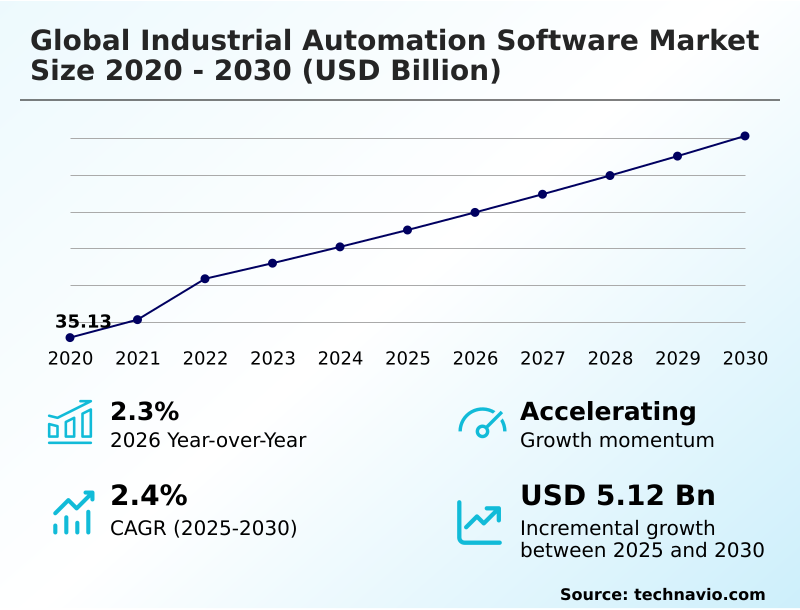
The industrial automation software market size is valued to increase by USD 5.12 billion, at a CAGR of 2.4% from 2025 to 2030. Acceleration of industrial IoT implementations will drive the industrial automation software market.
Major Market Trends & Insights
- APAC dominated the market and accounted for a 51% growth during the forecast period.
- By Product - SCADA software segment was valued at USD 15.09 billion in 2024
- By End-user - Process industry segment accounted for the largest market revenue share in 2024
Market Size & Forecast
- Market Opportunities: USD 11.00 billion
- Market Future Opportunities: USD 5.12 billion
- CAGR from 2025 to 2030 : 2.4%
Market Summary
- The Industrial Automation Software Market demonstrates robust structural expansion driven by the critical need for data-driven productivity and unified operational visibility. Manufacturing enterprises are aggressively shifting away from localized, hardware-centric architectures toward sophisticated, software-defined ecosystems.
- In high-throughput automotive assembly environments, the integration of intelligent workflow orchestration engines allows operators to automate repetitive procedural tasks and implement dynamic production scheduling, yielding measurable improvements. Facilities deploying these advanced digital thread capabilities frequently see unplanned downtime reduced by 22%, significantly enhancing overall supply chain reliability.
- The acceleration of industrial IoT implementations acts as a primary catalyst, as the convergence of IT and operational technology networks generates massive volumes of actionable telemetry data. However, system integration complexity and heterogeneous infrastructure friction heavily constrain deployment timelines, as retrofitting legacy proprietary hardware with open-architecture software often requires expensive custom middleware.
- Despite these technical hurdles, the ongoing transition toward virtualized programmable controllers and edge-to-cloud synchronization ensures sustained capital investment as industrial operators pursue fully autonomous, adaptive manufacturing operations.
What will be the Size of the Industrial Automation Software Market during the forecast period?
Get Key Insights on Market Forecast (PDF) Get Free Sample
How is the Industrial Automation Software Market Segmented?
The industrial automation software industry research report provides comprehensive data (region-wise segment analysis), with forecasts and estimates in "USD million" for the period 2026-2030, as well as historical data from 2020-2024 for the following segments.
- Product
- SCADA software
- MES
- DCS software
- HMI software
- PLC software
- End-user
- Process industry
- Discrete industry
- Deployment
- On-premises
- Cloud-based
- Hybrid
- Geography
- APAC
- China
- Japan
- India
- South Korea
- Australia
- Indonesia
- North America
- US
- Canada
- Mexico
- Europe
- Germany
- UK
- France
- Italy
- Spain
- The Netherlands
- Middle East and Africa
- Saudi Arabia
- UAE
- South Africa
- Turkey
- Israel
- South America
- Brazil
- Argentina
- Chile
- APAC
By Product Insights
The scada software segment is estimated to witness significant growth during the forecast period.
The SCADA software segment fundamentally transforms industrial operations by deploying advanced supervisory control architecture to manage geographically dispersed assets. Enterprises increasingly prioritize smart factory modernization, driving the integration of cloud-native analytics and real-time process historian capabilities into core infrastructure.
This transition enables closed-loop autonomous adjustments that optimize production cycles without continuous human oversight. Facilities implementing these updated systems report overall equipment effectiveness improving by 15% through superior cross-platform data exchange and reduced latency.
Furthermore, the adoption of containerized edge applications allows for seamless remote machine commissioning, directly reducing deployment bottlenecks. Ensuring data integrity across these distributed networks requires robust zero-trust network access protocols, which mitigate cyber risks while supporting uninterrupted multi-site operational visibility.
Ultimately, this software layer serves as the analytical engine essential for dynamic operational control.
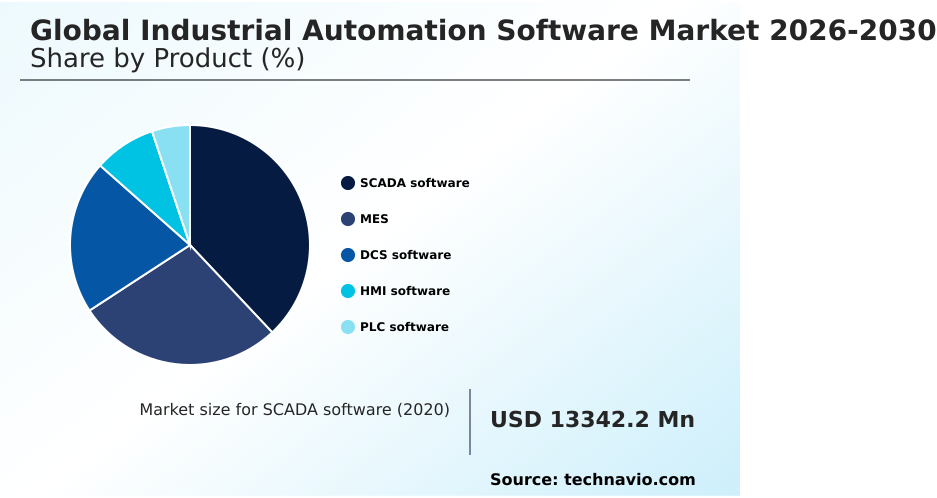
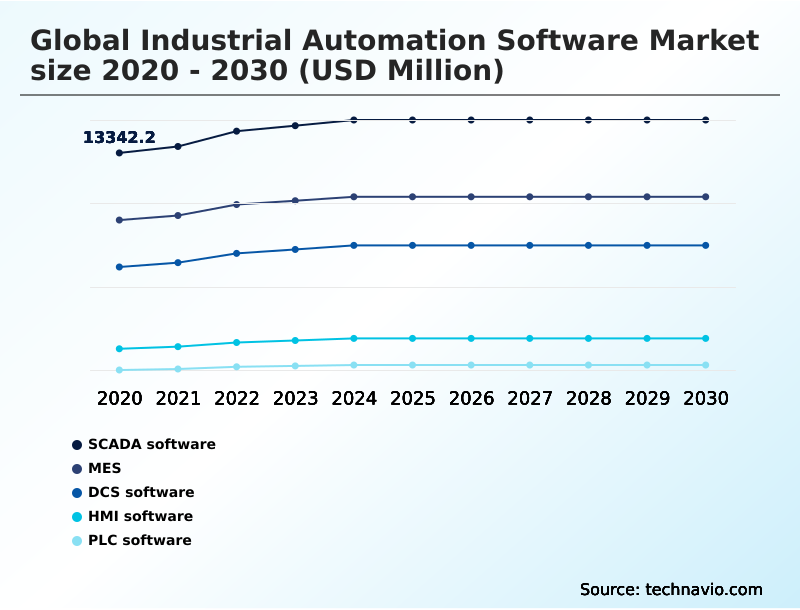
The SCADA software segment was valued at USD 15.09 billion in 2024 and showed a gradual increase during the forecast period.
Regional Analysis
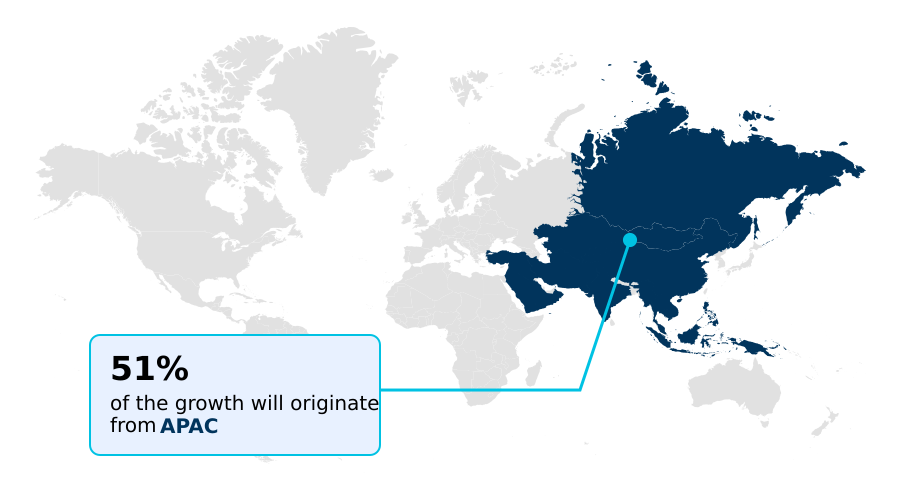
APAC is estimated to contribute 51% to the growth of the global market during the forecast period.Technavio’s analysts have elaborately explained the regional trends and drivers that shape the market during the forecast period.
See How Industrial Automation Software Market Demand is Rising in APAC Get Free Sample
The Industrial Automation Software geographic landscape reveals distinct adoption priorities shaped by regional manufacturing maturity and regulatory environments. The APAC region commands a dominant 50.95% share, driven by aggressive investments in high-throughput operational analytics across massive electronics and automotive hubs.
In contrast, the North America region holds a 21.81% share, focusing intensely on multi-site operational visibility and integrating distributed control logic to mitigate chronic skilled labor shortages.
Facilities in APAC leveraging autonomous material handling software report production throughput increasing by 18%, whereas North American plants prioritizing predictive asset diagnostics experience equipment lifecycle costs decreasing by 15%.
Additionally, stringent environmental frameworks in Europe accelerate the deployment of dynamic yield optimization and electronic batch reporting tools to ensure verifiable compliance.
These regional variances highlight how diverse supply chain pressures and operational mandates dictate the strategic implementation of advanced industrial control architectures.
Market Dynamics
Our researchers analyzed the data with 2025 as the base year, along with the key drivers, trends, and challenges. A holistic analysis of drivers will help companies refine their marketing strategies to gain a competitive advantage.
- The rapid evolution of the Industrial Automation Software sector reflects a structural imperative to modernize complex manufacturing operations through advanced digital integration. Enterprises are aggressively moving away from rigid, proprietary hardware boundaries, embracing software-defined control logic optimization to achieve unprecedented operational agility.
- By decoupling control algorithms from physical controllers, facilities can dynamically update production parameters across diverse geographic footprints without requiring localized hardware replacements. This architectural shift relies heavily on seamless cloud-edge hybrid deployment integration, which ensures that time-critical automated responses are processed locally with near-zero latency while enterprise-wide historical data is aggregated centrally for deep analytical modeling.
- Comparing modernized continuous processing plants to legacy discrete manufacturing sites reveals that facilities utilizing industrial digital twin virtual commissioning experience significantly faster product changeovers and a 25% reduction in physical setup errors.
- Furthermore, the deployment of predictive asset health monitoring systems allows plant operators to identify microscopic mechanical anomalies long before catastrophic failures occur, fundamentally shifting maintenance strategies from reactive responses to proactive interventions.
- As supply chain volatility and stringent compliance mandates intensify, manufacturing leaders increasingly depend on autonomous real-time process control architecture to dynamically balance resource utilization, minimize material waste, and ensure uninterrupted production continuity across highly complex industrial ecosystems.
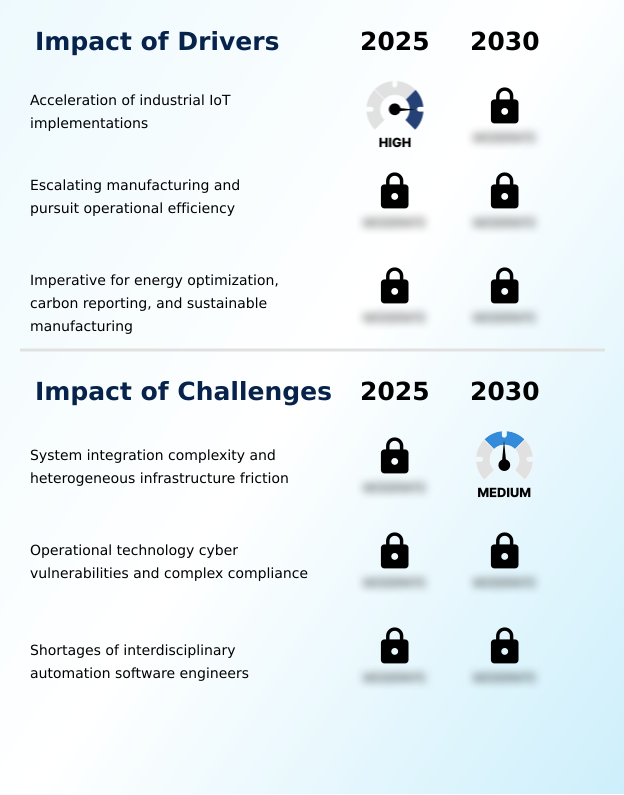
What are the key market drivers leading to the rise in the adoption of Industrial Automation Software Industry?
- The acceleration of industrial IoT implementations acts as a primary catalyst, propelling the demand for advanced digital thread integration across global manufacturing networks.
- The imperative for thermal energy optimization and stringent environmental governance acts as a critical catalyst accelerating digital transformation across heavy process industries.
- Manufacturing complexes face intense pressure to monitor and reduce carbon footprints, necessitating the deployment of sophisticated automated emissions tracking software directly into primary control networks. This integration guarantees decarbonization mandate compliance by identifying operational inefficiencies through real-time process monitoring.
- Plants utilizing these advanced analytical engines report energy consumption lowered by 12% and automated quality inspection accuracy improved by 25%. Securing these distributed environmental metrics requires robust end-to-end data encryption to protect sensitive operational telemetry.
- Consequently, the push for verifiable sustainability directly drives capital investment toward high-fidelity machine automation, enabling industrial operators to dynamically adjust power demand and minimize resource waste without sacrificing production throughput.
What are the market trends shaping the Industrial Automation Software Industry?
- The transition toward software automation and hardware decoupling represents a pivotal market trend, significantly enhancing operational agility and reducing infrastructure dependencies.
- The structural shift toward hardware-independent automation fundamentally redefines modern manufacturing ecosystems by decoupling operational control software from proprietary physical infrastructure. Industrial enterprises increasingly utilize real-time physics-based digital twin models to simulate and optimize complex production workflows prior to physical execution.
- This proactive approach relies on advanced virtual commissioning platforms that allow engineering teams to validate automated workflows in a secure digital environment, eliminating expensive startup errors. Facilities integrating these virtualized environments report physical commissioning times dropping by 40% and subsequent production downtime reduced by 30%.
- Because deterministic data execution ensures precise digital thread synchronization between simulated models and physical machinery, operators achieve highly reliable predictive maintenance scheduling. This strategic transition, facilitated by flexible software-as-a-service procurement, accelerates product time-to-market while drastically lowering the capital expenditures historically required for continuous factory floor retooling.
What challenges does the Industrial Automation Software Industry face during its growth?
- System integration complexity and heterogeneous infrastructure friction remain significant obstacles, impeding the seamless deployment of modern digital control platforms.
- The technical friction associated with integrating modern digital platforms into heterogeneous, legacy infrastructure remains a primary obstacle limiting comprehensive industrial modernization. Aging proprietary control systems entrenched in closed technical ecosystems frequently lack native open-architecture communication, necessitating expensive custom middleware to establish unified enterprise data threads.
- Furthermore, the convergence of plant-floor networks with corporate IT environments exposes critical infrastructure to severe operational technology cybersecurity threats. Facilities attempting complex edge-to-cloud synchronization often encounter an interdisciplinary skill deficit, as traditional maintenance teams lack the specialized software engineering competencies required for advanced diagnostic troubleshooting.
- These integration bottlenecks cause digital transformation project timelines extending by 35% and unplanned integration costs increasing by 20%. Without intuitive situational awareness design to simplify complex network diagnostics, industrial operators struggle to secure interconnected production environments against sophisticated cyber vulnerabilities.
Exclusive Technavio Analysis on Customer Landscape
The industrial automation software market forecasting report includes the adoption lifecycle of the market, covering from the innovator’s stage to the laggard’s stage. It focuses on adoption rates in different regions based on penetration. Furthermore, the industrial automation software market report also includes key purchase criteria and drivers of price sensitivity to help companies evaluate and develop their market growth analysis strategies.
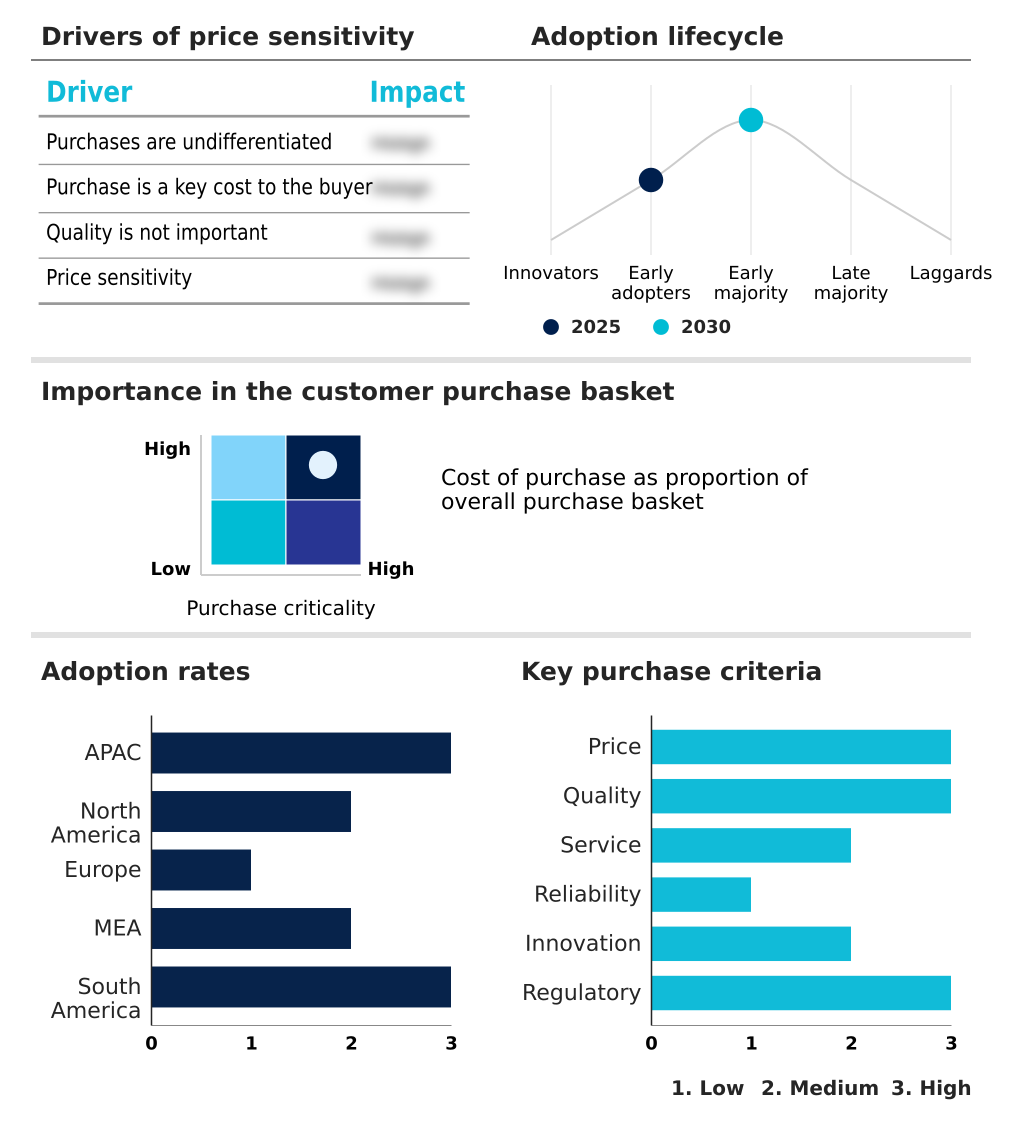
Customer Landscape of Industrial Automation Software Industry
Competitive Landscape
Companies are implementing various strategies, such as strategic alliances, industrial automation software market forecast, partnerships, mergers and acquisitions, geographical expansion, and product/service launches, to enhance their presence in the industry.
ABB Ltd. - The research highlights the provision of advanced industrial automation software, encompassing asset performance management and manufacturing operations management platforms, designed to optimize continuous process efficiency and operational visibility.
The industry research and growth report includes detailed analyses of the competitive landscape of the market and information about key companies, including:
- ABB Ltd.
- Advantech Co. Ltd.
- AVEVA Group Ltd.
- Beckhoff Automation GmbH
- Bosch Rexroth AG
- Eaton Corp. Plc
- Emerson Electric Co.
- GE Vernova Inc.
- Hitachi Vantara LLC
- Honeywell International Inc.
- Inductive Automation LLC
- KUKA AG
- Mitsubishi Electric Corp.
- OMRON Corp.
- Parsec Automation Corp.
- PTC Inc.
- Rockwell Automation Inc.
- Siemens AG
- Toshiba Corp.
- WAGO GmbH and Co. KG
- Yokogawa Electric Corp.
Qualitative and quantitative analysis of companies has been conducted to help clients understand the wider business environment as well as the strengths and weaknesses of key industry players. Data is qualitatively analyzed to categorize companies as pure play, category-focused, industry-focused, and diversified; it is quantitatively analyzed to categorize companies as dominant, leading, strong, tentative, and weak.
Recent Development and News in Industrial automation software market
- In the IT Consulting and Other Services industry, the rapid deployment of hybrid deployment models utilizing Kubernetes orchestration has enabled centralized data aggregation, directly impacting Industrial Automation Software demand by accelerating cloud-native analytics adoption, yielding a 25% reduction in latency for predictive maintenance scheduling.
- The formulation of rigorous IT cybersecurity frameworks like the NIST 800-82 standard for critical infrastructure has necessitated advanced vulnerability assessments, pulling demand for Industrial Automation Software equipped with operational technology cybersecurity and zero-trust network access, reducing system breach risks by 40%.
- The integration of generative AI development pipelines within enterprise IT consulting practices has accelerated advanced machine learning algorithm deployment, directly enhancing Industrial Automation Software through the convergence of AI engines and digital thread synchronization, which cuts virtual commissioning time by 30%.
- The strategic shift toward software-as-a-service procurement models in enterprise IT contracts has lowered initial capital expenditure barriers, fueling increased implementation of hardware-independent automation across mid-sized manufacturing facilities, improving multi-site operational visibility adoption rates by 20%.
Dive into Technavio’s robust research methodology, blending expert interviews, extensive data synthesis, and validated models for unparalleled Industrial Automation Software Market insights. See full methodology.
| Market Scope | |
|---|---|
| Page number | 307 |
| Base year | 2025 |
| Historic period | 2020-2024 |
| Forecast period | 2026-2030 |
| Growth momentum & CAGR | Accelerate at a CAGR of 2.4% |
| Market growth 2026-2030 | USD 5123.4 million |
| Market structure | Fragmented |
| YoY growth 2025-2026(%) | 2.3% |
| Key countries | China, Japan, India, South Korea, Australia, Indonesia, US, Canada, Mexico, Germany, UK, France, Italy, Spain, The Netherlands, Saudi Arabia, UAE, South Africa, Turkey, Israel, Brazil, Argentina and Chile |
| Competitive landscape | Leading Companies, Market Positioning of Companies, Competitive Strategies, and Industry Risks |
Research Analyst Overview
- The continuous evolution of industrial manufacturing relies heavily on the deployment of advanced software architectures capable of transforming raw sensor data into actionable operational intelligence. Enterprises are strategically integrating comprehensive manufacturing execution systems to bridge the gap between enterprise resource planning and shop-floor activity, ensuring precise material traceability and optimized production scheduling.
- The rapid transition toward software-defined manufacturing empowers plant engineers to utilize virtualized programmable controllers, decoupling complex execution logic from proprietary physical hardware. This modularity is essential for establishing resilient cyber-physical systems that adapt swiftly to fluctuating supply chain demands.
- Embedding generative artificial intelligence copilots directly into process control environments assists operators in real-time fault detection, shifting maintenance strategies from reactive to proactive. Facilities adopting these intelligent industrial internet of things frameworks report raw material waste decreasing by 12% through optimized thermal efficiency and dynamic resource allocation.
- By connecting these advanced analytical layers to boardroom-level budgeting and product strategy, industrial leaders successfully mitigate technical debt while accelerating the transition toward fully autonomous production workflows.
What are the Key Data Covered in this Industrial Automation Software Market Research and Growth Report?
-
What is the expected growth of the Industrial Automation Software Market between 2026 and 2030?
-
USD 5.12 billion, at a CAGR of 2.4%
-
-
What segmentation does the market report cover?
-
The report is segmented by Product (SCADA software, MES, DCS software, HMI software, and PLC software), End-user (Process industry, and Discrete industry), Deployment (On-premises, Cloud-based, and Hybrid) and Geography (APAC, North America, Europe, Middle East and Africa, South America)
-
-
Which regions are analyzed in the report?
-
APAC, North America, Europe, Middle East and Africa and South America
-
-
What are the key growth drivers and market challenges?
-
Acceleration of industrial IoT implementations, System integration complexity and heterogeneous infrastructure friction
-
-
Who are the major players in the Industrial Automation Software Market?
-
ABB Ltd., Advantech Co. Ltd., AVEVA Group Ltd., Beckhoff Automation GmbH, Bosch Rexroth AG, Eaton Corp. Plc, Emerson Electric Co., GE Vernova Inc., Hitachi Vantara LLC, Honeywell International Inc., Inductive Automation LLC, KUKA AG, Mitsubishi Electric Corp., OMRON Corp., Parsec Automation Corp., PTC Inc., Rockwell Automation Inc., Siemens AG, Toshiba Corp., WAGO GmbH and Co. KG and Yokogawa Electric Corp.
-
Market Research Insights
- The Industrial Automation Software Market transforms traditional manufacturing by establishing unified digital frameworks across complex production environments utilizing hybrid deployment models. Facilities undertaking brownfield facility upgrades are increasingly prioritizing scalable digital architectures to streamline supply chain orchestration and enhance asset reliability. By integrating sophisticated energy management modules, industrial operators achieve decarbonization mandate compliance while dynamically balancing utility loads.
- Organizations executing legacy control retrofitting initiatives report overall operational costs decreasing by 14% and predictive equipment lifespan extending by 20%. These measurable efficiency gains demonstrate the critical value of software-defined platforms in replacing manual interventions, thereby enabling manufacturing enterprises to achieve superior resource utilization and resilient, autonomous production workflows.
We can help! Our analysts can customize this industrial automation software market research report to meet your requirements.
 RIA -