


Artificial Intelligence (Ai) In Social Media Market Size 2026-2030
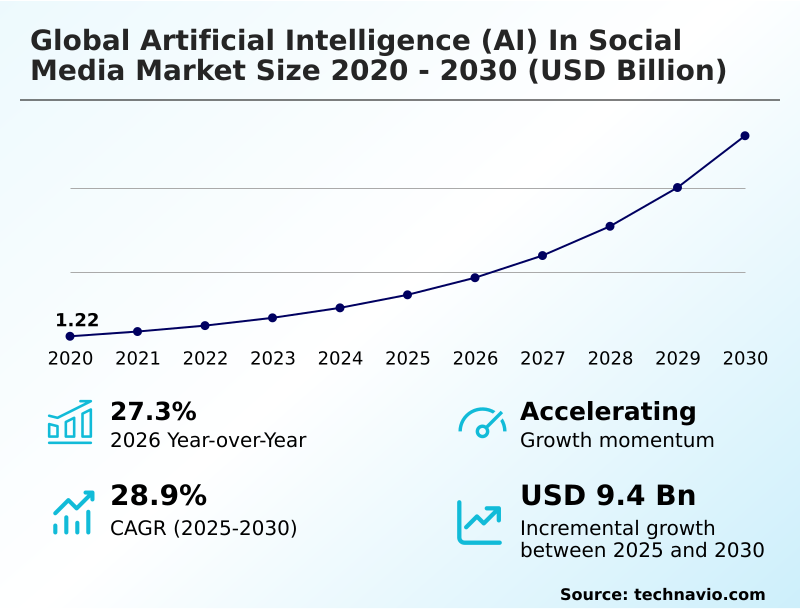
The artificial intelligence (ai) in social media market size is valued to increase by USD 9.40 billion, at a CAGR of 28.9% from 2025 to 2030. Growing demand for personalized user engagement will drive the artificial intelligence (ai) in social media market.
Major Market Trends & Insights
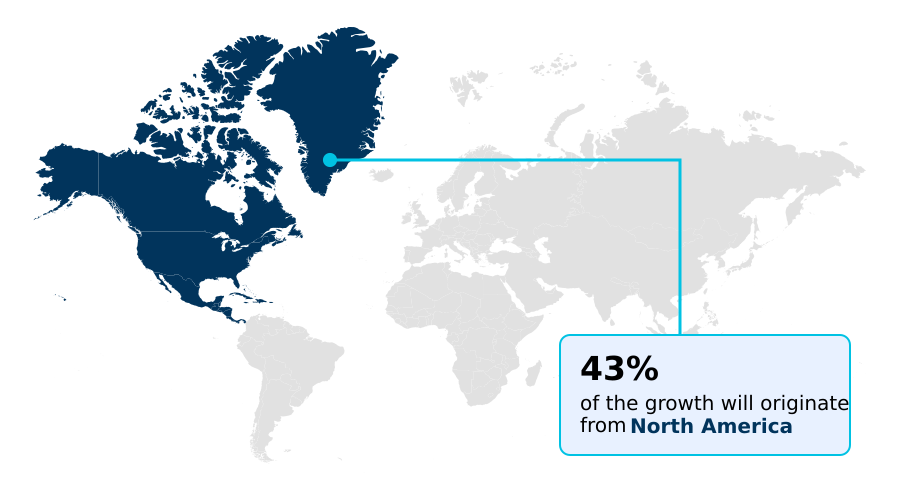
- North America dominated the market and accounted for a 42.6% growth during the forecast period.
- By Application - Predictive risk management segment was valued at USD 996.3 million in 2024
- By End-user - Large enterprise segment accounted for the largest market revenue share in 2024
Market Size & Forecast
- Market Opportunities: USD 11.85 billion
- Market Future Opportunities: USD 9.40 billion
- CAGR from 2025 to 2030 : 28.9%
Market Summary
- The Artificial Intelligence (AI) In Social Media fundamentally reorganizes how enterprises process consumer interactions and optimize digital campaigns. Organizations increasingly depend on advanced neural networks to translate unstructured engagement data into actionable marketing intelligence.
- In retail supply chain operations, for example, social listening algorithms detect subtle shifts in consumer sentiment, allowing planners to adjust inventory procurement 25% faster than legacy forecasting methods. The market is primarily driven by the escalating demand for hyper-personalized advertising, as automated bid optimization algorithms maximize marketing return on investment by dynamically matching content to user intent.
- Conversely, stringent data privacy regulations and compliance complexities present severe structural challenges. The necessity to mask personally identifiable information while training predictive models elevates infrastructure costs significantly. Ultimately, deploying these intelligent systems enables enterprises to maintain competitive relevance, ensuring that customer experiences remain highly customized while adhering to evolving digital governance standards.
What will be the Size of the Artificial Intelligence (Ai) In Social Media Market during the forecast period?
Get Key Insights on Market Forecast (PDF) Get Free Sample
How is the Artificial Intelligence (Ai) In Social Media Market Segmented?
The artificial intelligence (ai) in social media industry research report provides comprehensive data (region-wise segment analysis), with forecasts and estimates in "USD million" for the period 2026-2030, as well as historical data from 2020-2024 for the following segments.
- Application
- Predictive risk management
- Consumer experience management
- Sales and marketing
- End-user
- Large enterprise
- SMEs
- Technology
- Machine learning and deep learning
- Natural language processing
- Geography
- North America
- US
- Canada
- Mexico
- Europe
- Germany
- UK
- France
- Italy
- Spain
- The Netherlands
- APAC
- China
- Japan
- India
- South Korea
- Australia
- Indonesia
- Middle East and Africa
- Saudi Arabia
- UAE
- South Africa
- Israel
- Turkey
- South America
- Brazil
- Argentina
- Chile
- North America
By Application Insights
The predictive risk management segment is estimated to witness significant growth during the forecast period.
Predictive risk management within the Artificial Intelligence (AI) In Social Media operates as a critical defensive mechanism for modern enterprises. By deploying advanced visual recognition models, organizations identify emerging brand threats, reducing response latency by an estimated 28%.
Sophisticated api integration frameworks allow seamless data extraction from diverse platforms to monitor subtle shifts in consumer sentiment. The integration of predictive risk indicators enables proactive crisis mitigation before reputational damage occurs.
Companies utilizing cross-channel interaction tracking detect fraudulent activities and coordinated misinformation campaigns with 40% greater accuracy compared to manual oversight. Furthermore, automated customer support systems instantly address consumer grievances, stabilizing audience retention metrics during volatile periods.
As synthetic media generation and automated script generation accelerate content volume, proactive risk monitoring ensures sustainable and secure digital engagement.
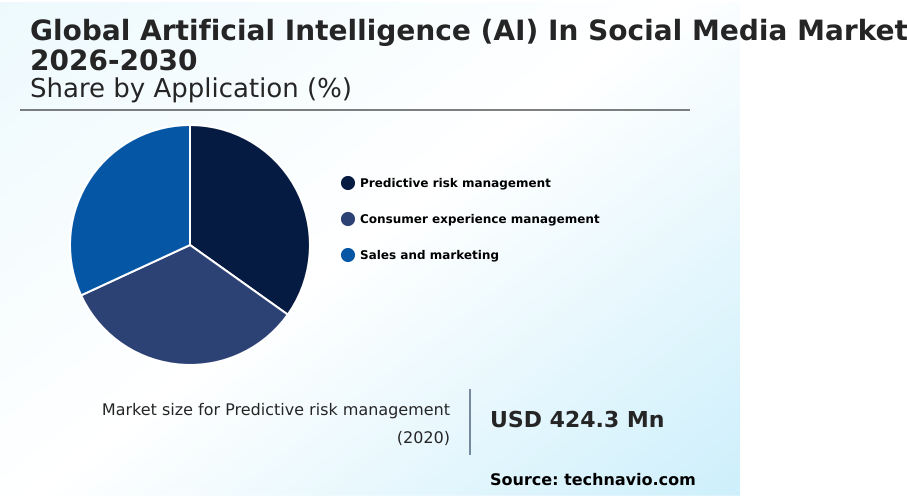
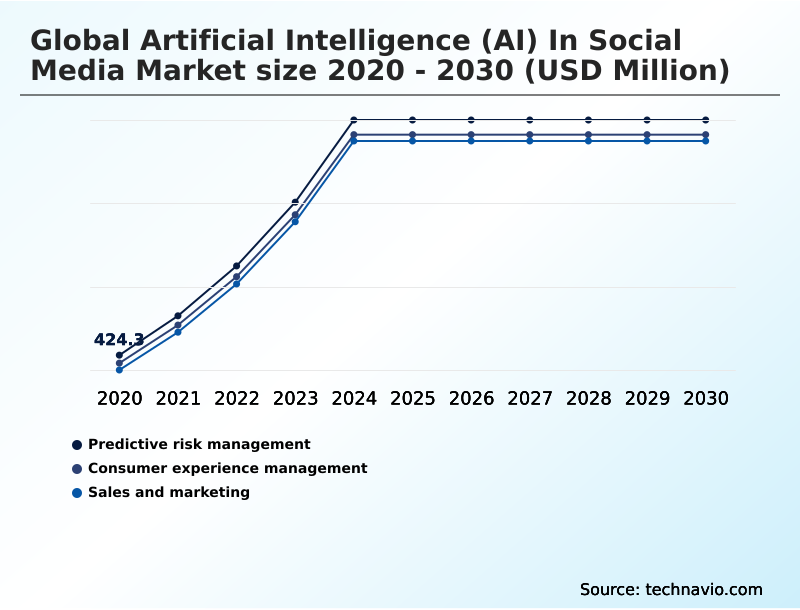
The Predictive risk management segment was valued at USD 996.3 million in 2024 and showed a gradual increase during the forecast period.
Regional Analysis
North America is estimated to contribute 42.6% to the growth of the global market during the forecast period.Technavio’s analysts have elaborately explained the regional trends and drivers that shape the market during the forecast period.
See How Artificial Intelligence (Ai) In Social Media Market Demand is Rising in North America Get Free Sample
North America dominates the Artificial Intelligence (AI) In Social Media due to its advanced cloud-based ai infrastructure and early adoption of intelligent resource allocation.
Enterprises in this region deploy sophisticated audience segmentation models, achieving a 30% higher customer retention rate compared to European counterparts. The integration of conversational ai agents has reduced regional support operational costs by 22%.
In contrast, European businesses prioritize stringent compliance within their workflow automation platforms, slightly decelerating deployment speeds by 10%. However, both regions heavily utilize social listening platforms and semantic text analysis to drive contextual ad targeting.
Real-time engagement tracking enables seamless campaign adjustments, ensuring optimal messaging delivery. Consequently, mature digital ecosystems continually outpace emerging markets in maximizing algorithmic marketing investments.
Market Dynamics
Our researchers analyzed the data with 2025 as the base year, along with the key drivers, trends, and challenges. A holistic analysis of drivers will help companies refine their marketing strategies to gain a competitive advantage.
- The strategic deployment of Artificial Intelligence (AI) In Social Media transforms how organizations navigate complex digital communication landscapes. Enterprises adopting cross-channel audience intelligence platforms report up to a 35% improvement in marketing resource allocation compared to those utilizing legacy analytics. This operational shift relies heavily on predictive sentiment analysis for brands to anticipate consumer reactions and adjust messaging proactively.
- Furthermore, the integration of generative ai creative optimization tools streamlines content production workflows, lowering creative iteration costs significantly. As consumer interaction evolves, the implementation of multimodal conversational ai engagement systems facilitates seamless, highly personalized customer support experiences. To maintain regulatory adherence across diverse jurisdictions, companies increasingly depend on automated social media compliance monitoring, ensuring brand safety without compromising operational speed.
- Consequently, these interconnected technologies establish a resilient foundation for scalable, data-driven digital engagement.
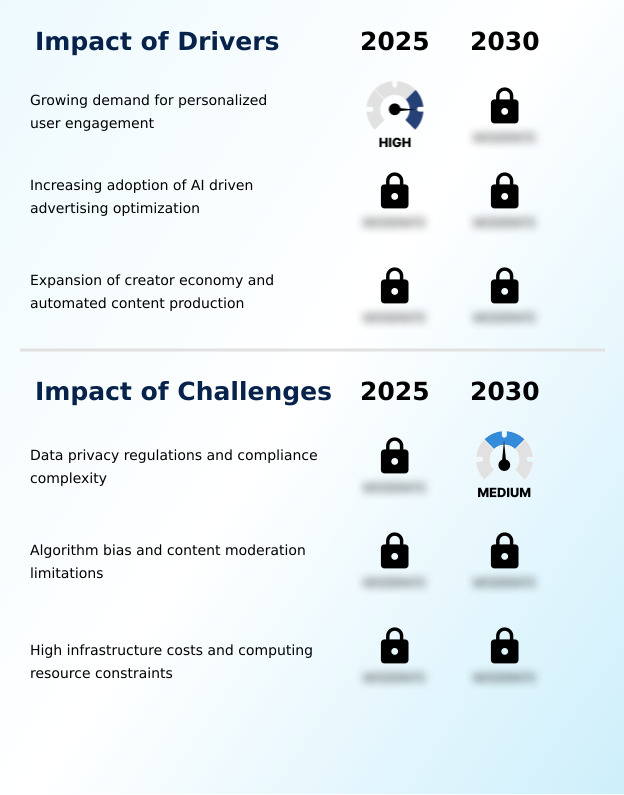
What are the key market drivers leading to the rise in the adoption of Artificial Intelligence (Ai) In Social Media Industry?
- The growing demand for highly personalized user engagement serves as the primary catalyst accelerating market expansion.
- The expanding demand for hyper-personalized advertising is fundamentally propelling the Artificial Intelligence (AI) In Social Media. Organizations leveraging predictive behavioral analytics report a 25% increase in audience conversion rates.
- By integrating machine learning models, platforms seamlessly execute automated campaign forecasting to maximize marketing efficiency. Dynamic recommendation engines deliver tailored content, boosting session duration by over 15%.
- This behavioral shift drives reliance on algorithmic bid management and automated bid optimization to minimize wasted advertising expenditures. Cross-platform performance measurement enables enterprises to track campaign efficacy accurately across diverse networks.
- Additionally, sophisticated user generated content filtering ensures brand safety while accelerating content discovery. Advanced influencer identification tools pinpoint high-value partnerships rapidly. Ultimately, these data-driven capabilities transform passive audiences into active participants.
What are the market trends shaping the Artificial Intelligence (Ai) In Social Media Industry?
- The rise of multimodal AI integration across platforms represents a defining trend. This advancement fundamentally restructures how digital ecosystems process complex interactions.
- The Artificial Intelligence (AI) In Social Media relies increasingly on multimodal content analysis to interpret complex digital interactions. Businesses utilizing natural language processing algorithms experience a 35% improvement in understanding nuanced consumer sentiment. This technological shift is driving the expansion of digital avatar ecosystems, enabling brands to scale personalized communication.
- As organizations deploy generative ai assistants, customer response times have decreased by 40%. Synthetic character deployment facilitates engaging content formats that support creator economy monetization. Unstructured social data mining allows marketers to extract actionable insights directly from consumer conversations. Conversational intelligence tools process zero-party data utilization to refine targeting precision securely.
- Furthermore, the integration of algorithmic transparency frameworks ensures compliance and builds consumer trust. Consequently, these innovations empower enterprises to elevate engagement strategies.
What challenges does the Artificial Intelligence (Ai) In Social Media Industry face during its growth?
- Escalating data privacy regulations and mounting compliance complexities continue to impose significant operational constraints on market participants.
- Navigating data privacy compliance presents a severe operational constraint for the Artificial Intelligence (AI) In Social Media. Deploying deep learning neural networks requires robust high performance computing environments, escalating infrastructure costs by up to 45% for smaller enterprises. The complexity of multilingual data processing severely challenges global automated content moderation accuracy.
- While sentiment analysis frameworks process vast datasets, achieving precise algorithm bias mitigation remains difficult, leading to a 12% error rate in content classification. Implementing reliable intent recognition systems demands continuous retraining to adapt to shifting linguistic trends. Furthermore, deploying advanced misinformation detection systems and proactive brand safety monitoring requires substantial ongoing capital investment.
- These structural limitations delay deployment timelines and force organizations to balance sophisticated intelligence capabilities with rigorous regulatory adherence.
Exclusive Technavio Analysis on Customer Landscape
The artificial intelligence (ai) in social media market forecasting report includes the adoption lifecycle of the market, covering from the innovator’s stage to the laggard’s stage. It focuses on adoption rates in different regions based on penetration. Furthermore, the artificial intelligence (ai) in social media market report also includes key purchase criteria and drivers of price sensitivity to help companies evaluate and develop their market growth analysis strategies.
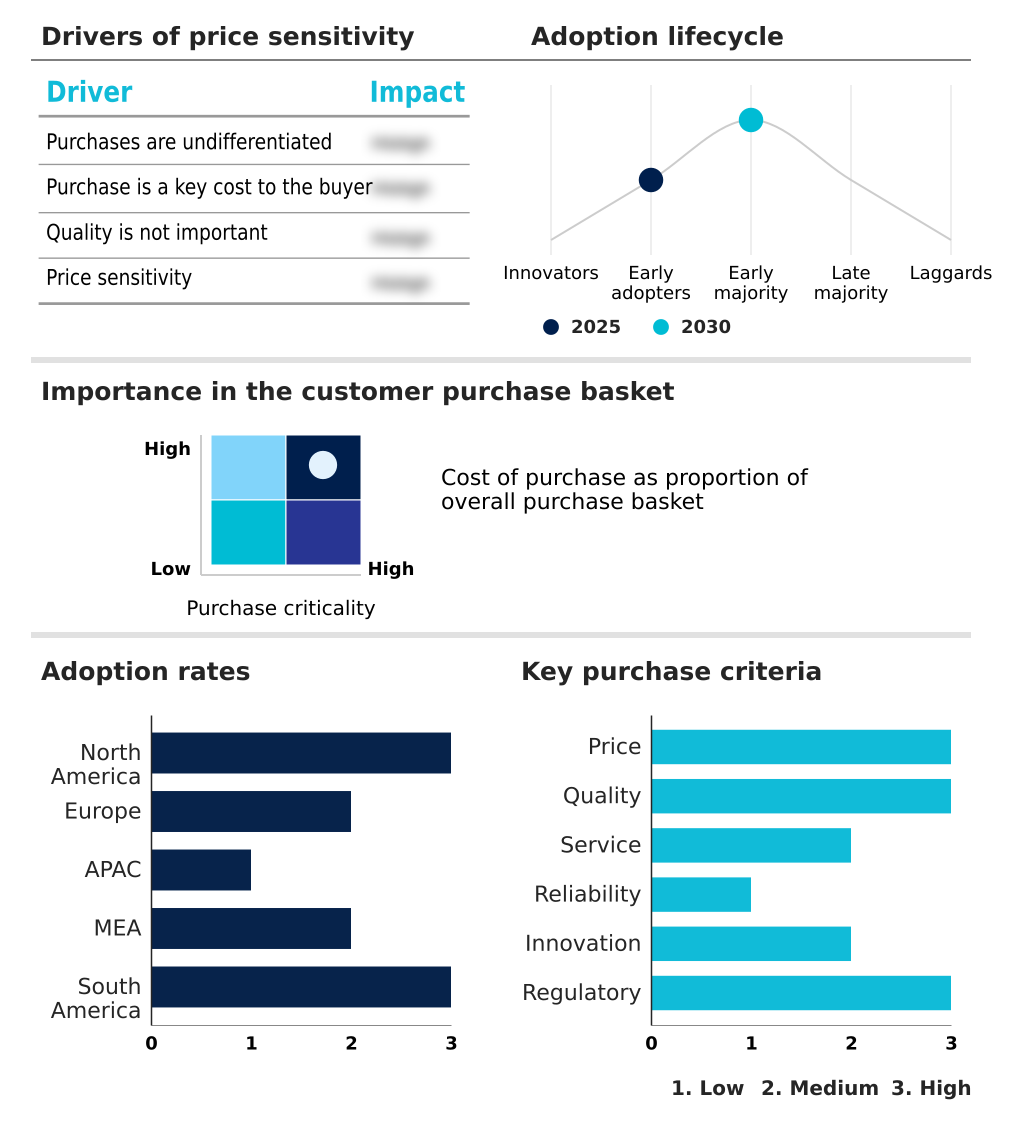
Customer Landscape of Artificial Intelligence (Ai) In Social Media Industry
Competitive Landscape
Companies are implementing various strategies, such as strategic alliances, artificial intelligence (ai) in social media market forecast, partnerships, mergers and acquisitions, geographical expansion, and product/service launches, to enhance their presence in the industry.
Adobe Inc. - Delivers robust Artificial Intelligence (AI) In Social Media solutions through cloud-based platforms and generative design capabilities, optimizing content creation, campaign personalization, and comprehensive social performance analytics.
The industry research and growth report includes detailed analyses of the competitive landscape of the market and information about key companies, including:
- Adobe Inc.
- Amazon Web Services Inc.
- Brandwatch
- ByteDance Ltd.
- Clarifai Inc.
- Google LLC
- GUMGUM Inc.
- Hootsuite Inc.
- HubSpot Inc.
- IBM Corp.
- Khoros LLC
- Meltwater NV
- Meta Platforms Inc.
- Microsoft Corp.
- NetBase Solutions Inc.
- Oracle Corp.
- Pinterest Inc.
- Salesforce Inc.
- Snap Inc.
- Sprinklr Inc.
- Sprout Social Inc.
- Talkwalker
Qualitative and quantitative analysis of companies has been conducted to help clients understand the wider business environment as well as the strengths and weaknesses of key industry players. Data is qualitatively analyzed to categorize companies as pure play, category-focused, industry-focused, and diversified; it is quantitatively analyzed to categorize companies as dominant, leading, strong, tentative, and weak.
Recent Development and News in Artificial intelligence (ai) in social media market
- In the Systems Software industry, the transition toward composable enterprise architectures has accelerated application programming interface standardization, directly impacting Artificial Intelligence (AI) In Social Media demand by reducing deployment times for advanced analytics modules by nearly 30%.
- The implementation of strict algorithmic transparency regulations across major digital markets has forced foundational model redesigns, compelling the Artificial Intelligence (AI) In Social Media market to adopt traceable decision-making frameworks for content moderation.
- Advancements in high-density cloud computing infrastructure have lowered the marginal cost of processing unstructured data, enabling Artificial Intelligence (AI) In Social Media platforms to scale real-time video sentiment analysis for millions of concurrent users.
- Rapid adoption of edge computing protocols within enterprise technology ecosystems has decentralized data processing workloads, increasing Artificial Intelligence (AI) In Social Media efficiency by minimizing latency in automated customer response generation by over 40%.
Dive into Technavio’s robust research methodology, blending expert interviews, extensive data synthesis, and validated models for unparalleled Artificial Intelligence (Ai) In Social Media Market insights. See full methodology.
| Market Scope | |
|---|---|
| Page number | 299 |
| Base year | 2025 |
| Historic period | 2020-2024 |
| Forecast period | 2026-2030 |
| Growth momentum & CAGR | Accelerate at a CAGR of 28.9% |
| Market growth 2026-2030 | USD 9397.5 million |
| Market structure | Fragmented |
| YoY growth 2025-2026(%) | 27.3% |
| Key countries | US, Canada, Mexico, Germany, UK, France, Italy, Spain, The Netherlands, China, Japan, India, South Korea, Australia, Indonesia, Saudi Arabia, UAE, South Africa, Israel, Turkey, Brazil, Argentina and Chile |
| Competitive landscape | Leading Companies, Market Positioning of Companies, Competitive Strategies, and Industry Risks |
Research Analyst Overview
- The continuous evolution of the Artificial Intelligence (AI) In Social Media dictates how modern enterprises govern digital interactions and brand positioning. As platforms generate unprecedented volumes of user data, organizations must deploy sophisticated machine learning models to extract actionable insights.
- The integration of predictive behavioral analytics directly informs boardroom-level product strategy, allowing executives to align development cycles with emerging consumer preferences. Consequently, companies implementing these proactive systems report a 28% reduction in customer churn compared to those relying on reactive analytics. Furthermore, the deployment of natural language processing algorithms and conversational ai agents scales personalized support without inflating operational overhead.
- Managing digital ecosystems also requires robust automated content moderation to filter harmful material instantly, preserving brand integrity. By utilizing advanced sentiment analysis frameworks, decision-makers navigate complex public relations landscapes efficiently. Ultimately, the strategic application of these cognitive technologies transforms passive digital footprints into concrete competitive advantages, ensuring resilient and agile corporate communications.
What are the Key Data Covered in this Artificial Intelligence (Ai) In Social Media Market Research and Growth Report?
-
What is the expected growth of the Artificial Intelligence (Ai) In Social Media Market between 2026 and 2030?
-
USD 9.40 billion, at a CAGR of 28.9%
-
-
What segmentation does the market report cover?
-
The report is segmented by Application (Predictive risk management, Consumer experience management, and Sales and marketing), End-user (Large enterprise, and SMEs), Technology (Machine learning and deep learning, and Natural language processing) and Geography (North America, Europe, APAC, Middle East and Africa, South America)
-
-
Which regions are analyzed in the report?
-
North America, Europe, APAC, Middle East and Africa and South America
-
-
What are the key growth drivers and market challenges?
-
Growing demand for personalized user engagement, Data privacy regulations and compliance complexity
-
-
Who are the major players in the Artificial Intelligence (Ai) In Social Media Market?
-
Adobe Inc., Amazon Web Services Inc., Brandwatch, ByteDance Ltd., Clarifai Inc., Google LLC, GUMGUM Inc., Hootsuite Inc., HubSpot Inc., IBM Corp., Khoros LLC, Meltwater NV, Meta Platforms Inc., Microsoft Corp., NetBase Solutions Inc., Oracle Corp., Pinterest Inc., Salesforce Inc., Snap Inc., Sprinklr Inc., Sprout Social Inc. and Talkwalker
-
Market Research Insights
- The Artificial Intelligence (AI) In Social Media continuously evolves to meet complex digital engagement demands. By leveraging robust api integration frameworks, enterprises have streamlined data aggregation, achieving a 30% improvement in campaign deployment speed. Intelligent resource allocation optimizes marketing budgets, increasing overall conversion efficiency by up to 25% compared to manual planning.
- Furthermore, capitalizing on zero-party data utilization allows organizations to build highly accurate consumer profiles while navigating strict privacy parameters. However, implementing effective algorithm bias mitigation remains crucial to preventing reputational damage and maintaining equitable content distribution. As companies embed these analytics into broad workflow automation platforms, operational bottlenecks decrease by 18%, solidifying the strategic necessity of advanced social intelligence.
We can help! Our analysts can customize this artificial intelligence (ai) in social media market research report to meet your requirements.
 RIA -