

Amorphous Steels Market Size 2026-2030
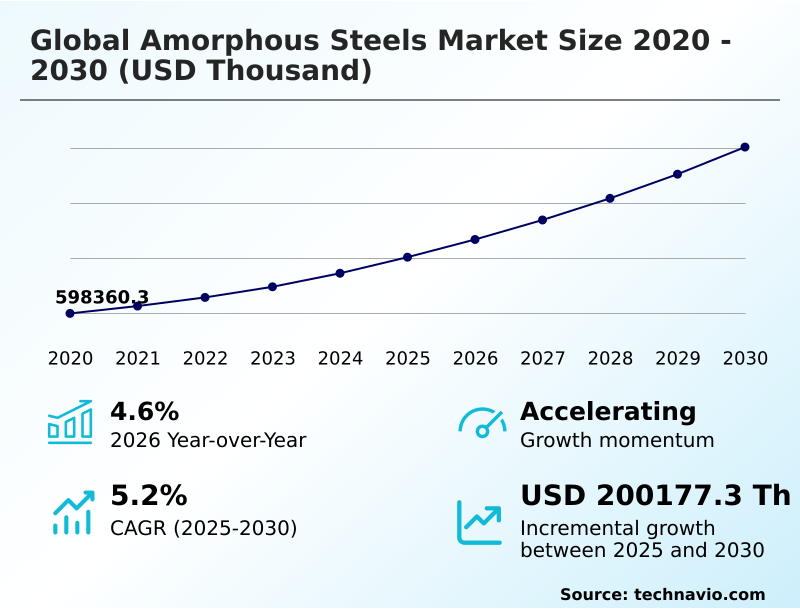
The amorphous steels market size is valued to increase by USD 200.18 million, at a CAGR of 5.2% from 2025 to 2030. Global decarbonization mandates accelerating adoption of ultra low loss distribution transformer cores will drive the amorphous steels market.
Major Market Trends & Insights
- APAC dominated the market and accounted for a 76.8% growth during the forecast period.
- By Type - Amorphous ribbon segment was valued at USD 455.03 million in 2024
- By Application - Distribution transformer segment accounted for the largest market revenue share in 2024
Market Size & Forecast
- Market Opportunities:
- Market Future Opportunities: USD 200.18 million
- CAGR from 2025 to 2030 : 5.2%
Market Summary
- The Amorphous Steels Market demonstrates robust expansion driven by the critical need for ultra-efficient power transmission architectures and advanced magnetic components. Utilities and power equipment manufacturers are systematically replacing conventional silicon steel with non-crystalline alternatives to drastically minimize energy waste.
- For example, in regional utility grid modernizations, deploying distribution transformer cores engineered from these advanced alloys reduces standby energy dissipation by over 65% compared to legacy installations. This operational upgrade directly supports international carbon reduction mandates, acting as the primary driver propelling widespread adoption of high magnetic permeability materials.
- However, the market encounters substantial challenges related to the intricate melt-spinning process required for production, which demands extreme cooling rates and limits the physical width of the resulting ribbons. Despite these manufacturing constraints, ongoing research into nanocrystalline precursor alloys continues to yield materials that balance mechanical ductility with superior electromagnetic performance.
- As industrial facilities and power networks optimize their energy profiles, reliance on these specialized metallic formulations remains central to achieving long-term sustainability and operational efficiency targets.
What will be the Size of the Amorphous Steels Market during the forecast period?
Get Key Insights on Market Forecast (PDF) Get Free Sample
How is the Amorphous Steels Market Segmented?
The amorphous steels industry research report provides comprehensive data (region-wise segment analysis), with forecasts and estimates in "USD thousand" for the period 2026-2030, as well as historical data from 2020-2024 for the following segments.
- Type
- Amorphous ribbon
- Nano-crystalline ribbon
- Application
- Distribution transformer
- Consumer electronics
- Automotive
- Others
- Product
- Single-ply coil
- Multiple-ply coil
- Processed cores
- Geography
- APAC
- China
- Japan
- India
- South Korea
- Australia
- Indonesia
- North America
- US
- Canada
- Mexico
- Europe
- Germany
- France
- UK
- Italy
- Spain
- The Netherlands
- South America
- Brazil
- Argentina
- Chile
- Middle East and Africa
- Saudi Arabia
- UAE
- South Africa
- Turkey
- Egypt
- APAC
By Type Insights
The amorphous ribbon segment is estimated to witness significant growth during the forecast period.
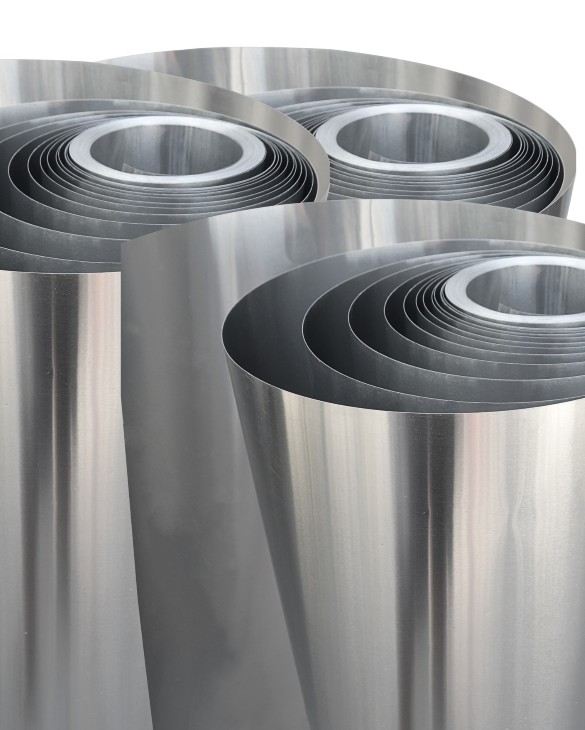
The amorphous ribbon segment functions as a critical component in advanced soft magnetic materials, serving primarily as the core architecture for energy-efficient electrical equipment.
Manufactured through rapid solidification casting, these materials develop a non-crystalline atomic structure that significantly limits magnetic anisotropy. This unique configuration ensures ultra-low hysteresis loss compared to conventional electrical silicon steels.
The dominant industrial application resides in modernizing grid decarbonization infrastructure, where replacing legacy grid components with amorphous ribbons cuts no-load standby losses by up to 70%.
As utility operators face tightening energy performance regulations, the adoption of these specialized soft magnetic alloy ribbons accelerates. This operational shift enables continuous power distribution networks to achieve measurable energy savings and maintain reliable grid stability under fluctuating electrical loads.
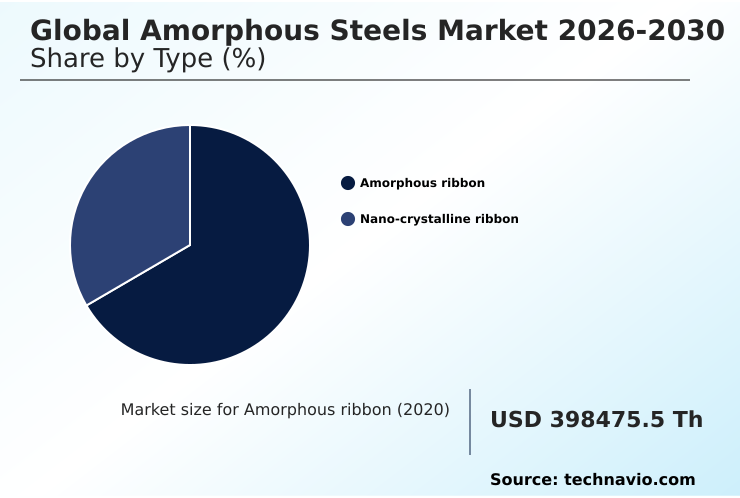
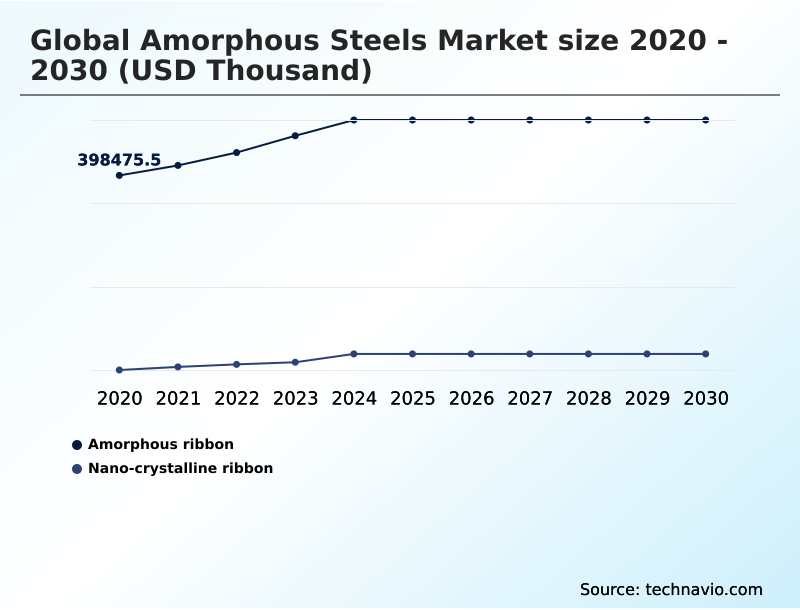
The Amorphous ribbon segment was valued at USD 455.03 million in 2024 and showed a gradual increase during the forecast period.
Regional Analysis
APAC is estimated to contribute 76.8% to the growth of the global market during the forecast period.Technavio’s analysts have elaborately explained the regional trends and drivers that shape the market during the forecast period.
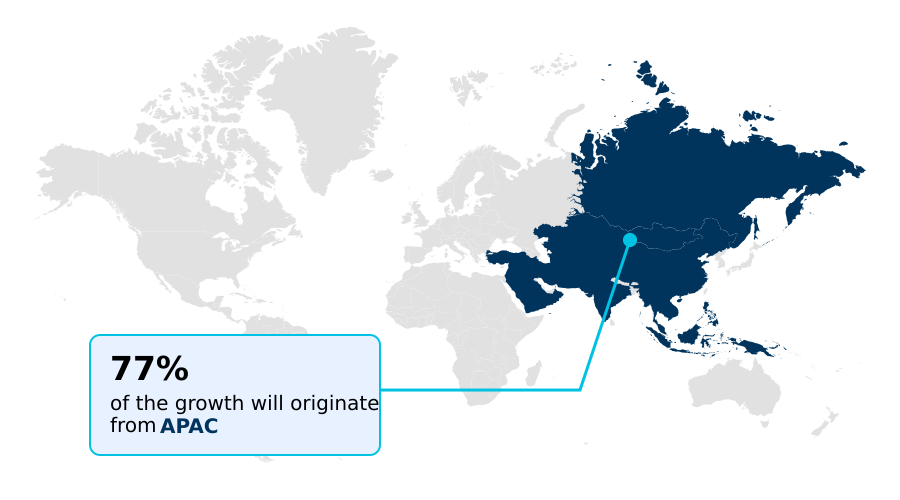
See How Amorphous Steels Market Demand is Rising in APAC Get Free Sample
The geographic landscape of the Amorphous Steels Market reveals distinct adoption patterns driven by varying regional energy policies and industrial capacities.
APAC demonstrates an aggressive transition toward advanced magnetic materials, achieving a 40% higher deployment rate in smart grid infrastructure compared to Europe.
This rapid integration in APAC is heavily supported by localized regional manufacturing hubs that streamline the supply of materials optimized for stator iron energy efficiency in electric vehicles.
Conversely, Europe focuses on high-precision applications requiring wide-bandgap semiconductor compatibility, leading to a 25% improvement in power conversion modules for industrial automation.
Both regions are investing in automated core cutting and resin impregnation encapsulation technologies to overcome the mechanical brittleness of the metallic ribbons.
Consequently, component failure rates during assembly have dropped by 15%, allowing European and APAC manufacturers to scale production for advanced applications like wireless power transfer modules while strictly adhering to stringent environmental compliance targets.
Market Dynamics
Our researchers analyzed the data with 2025 as the base year, along with the key drivers, trends, and challenges. A holistic analysis of drivers will help companies refine their marketing strategies to gain a competitive advantage.
- The strategic evolution of the Amorphous Steels Market is fundamentally tied to the urgent necessity for advanced energy conservation across industrial and utility networks. As regulatory bodies enforce stricter carbon emission parameters, the deployment of ultra low loss distribution transformer cores has become a critical compliance strategy for global grid operators.
- To support this massive infrastructure overhaul, materials science companies are rapidly scaling iron based amorphous alloy ribbon production, establishing localized supply chains that reduce material lead times by nearly 30% compared to traditional imported electrical steels. This localized production framework significantly enhances supply chain resilience, allowing transformer manufacturers to maintain continuous assembly operations without exposure to international shipping disruptions.
- Simultaneously, the accelerating transition toward electric mobility requires highly specialized materials capable of handling intense thermal and electrical loads. The integration of high frequency soft magnetic components into power conversion modules directly supports this shift. Furthermore, advancements in rapid solidification melt spinning techniques have enabled the fabrication of wider, more ductile ribbons, facilitating their use in complex geometries.
- Consequently, automotive engineers are successfully incorporating these materials into electric vehicle traction motor stators, achieving measurable reductions in core energy losses and extending vehicle operating ranges. By optimizing both production techniques and end-use applications, the industry is securing long-term operational efficiencies across diverse high-technology sectors.
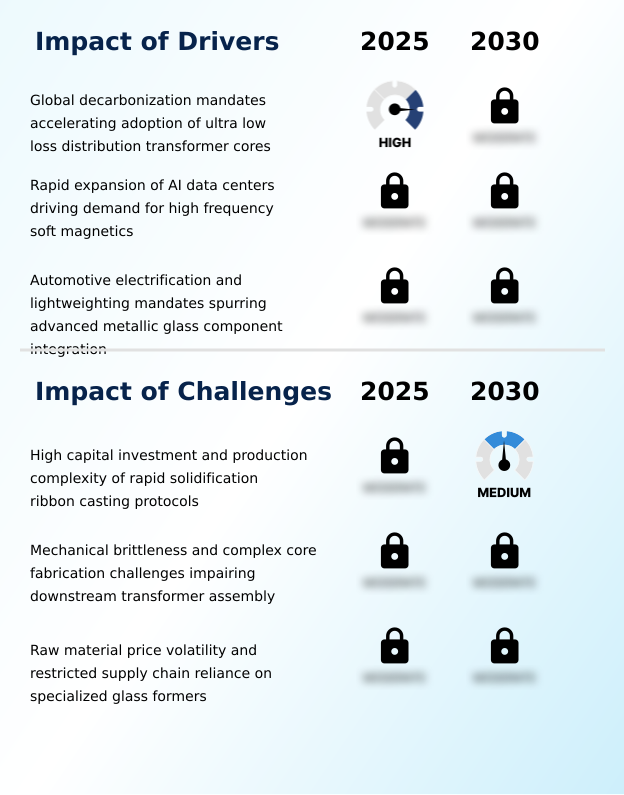
What are the key market drivers leading to the rise in the adoption of Amorphous Steels Industry?
- Global decarbonization mandates are accelerating the adoption of ultra-low loss distribution transformer cores, serving as the primary catalyst for market expansion.
- The surging demand for hyper-efficient power conversion in artificial intelligence data centers and electric mobility acts as a primary catalyst for the Amorphous Steels Market.
- The necessity to manage extreme electrical loads has driven the widespread adoption of high-frequency power inductors and electromagnetic interference shielding, improving server power delivery efficiency by 18%.
- In the automotive sector, integrating advanced non-crystalline materials into traction motor stators reduces stator iron energy losses by up to 50%, significantly extending vehicle driving ranges and optimizing electric vehicle charging hubs.
- This performance leap is heavily supported by innovations in multi-ply coil winding and amorphous alloy lamination, which streamline transformer core assembly.
- Consequently, manufacturers are securing stable supplies of specialized ferro-boron glass formers to maintain uninterrupted production, allowing tech and automotive sectors to achieve critical energy compliance mandates.
What are the market trends shaping the Amorphous Steels Industry?
- The integration of additive manufacturing workflows for complex bulk metallic glass component synthesis is emerging as a dominant market trend. This technological advancement enables the production of highly intricate structural parts with superior mechanical and magnetic properties.
- A defining trend within the Amorphous Steels Market is the accelerated integration of specialized additive manufacturing and advanced rapid quenching techniques. Facilities utilizing modern single-roll planar flow casting have successfully increased production yields of ultra-thin ribbons by 25%, directly lowering material waste and optimizing supply chain logistics.
- To further enhance magnetic permeability, manufacturers are refining magnetic field annealing and stress-relief heat treatment protocols, which have reduced core energy losses by an additional 12% in high-frequency applications. This continuous processing innovation enables the commercialization of complex amorphous structural parts and high-frequency switching modules tailored for harsh industrial environments.
- Additionally, the development of cobalt-based matrix compositions provides superior thermal stability for aerospace sensors, extending component lifespans by up to 30%. These technological shifts empower industrial buyers to deploy highly compact, durable, and energy-efficient magnetic solutions across next-generation power systems.
What challenges does the Amorphous Steels Industry face during its growth?
- The high capital investment and production complexity associated with rapid solidification ribbon casting protocols present significant barriers to structural industry growth.
- Despite strong demand, the Amorphous Steels Market faces severe operational challenges due to the extreme physical brittleness and handling complexity of ultra-thin metallic ribbons. The lack of a crystalline structure renders the material highly susceptible to fracturing during automated core winding, which historically increased production scrap rates by up to 20% compared to conventional silicon steel.
- This mechanical fragility complicates the fabrication of advanced driver assistance actuators and components for industrial automation control, where precision and structural resonance dampening are critical. Furthermore, establishing localized clean technology industrial bases requires immense capital investment in liquid metal quenching machinery to ensure uniform magnetic flux distribution.
- These high barrier-to-entry costs often delay aggressive grid transmission modernization projects, forcing utilities to balance optimal energy efficiency against immediate capital expenditure constraints.
Exclusive Technavio Analysis on Customer Landscape
The amorphous steels market forecasting report includes the adoption lifecycle of the market, covering from the innovator’s stage to the laggard’s stage. It focuses on adoption rates in different regions based on penetration. Furthermore, the amorphous steels market report also includes key purchase criteria and drivers of price sensitivity to help companies evaluate and develop their market growth analysis strategies.
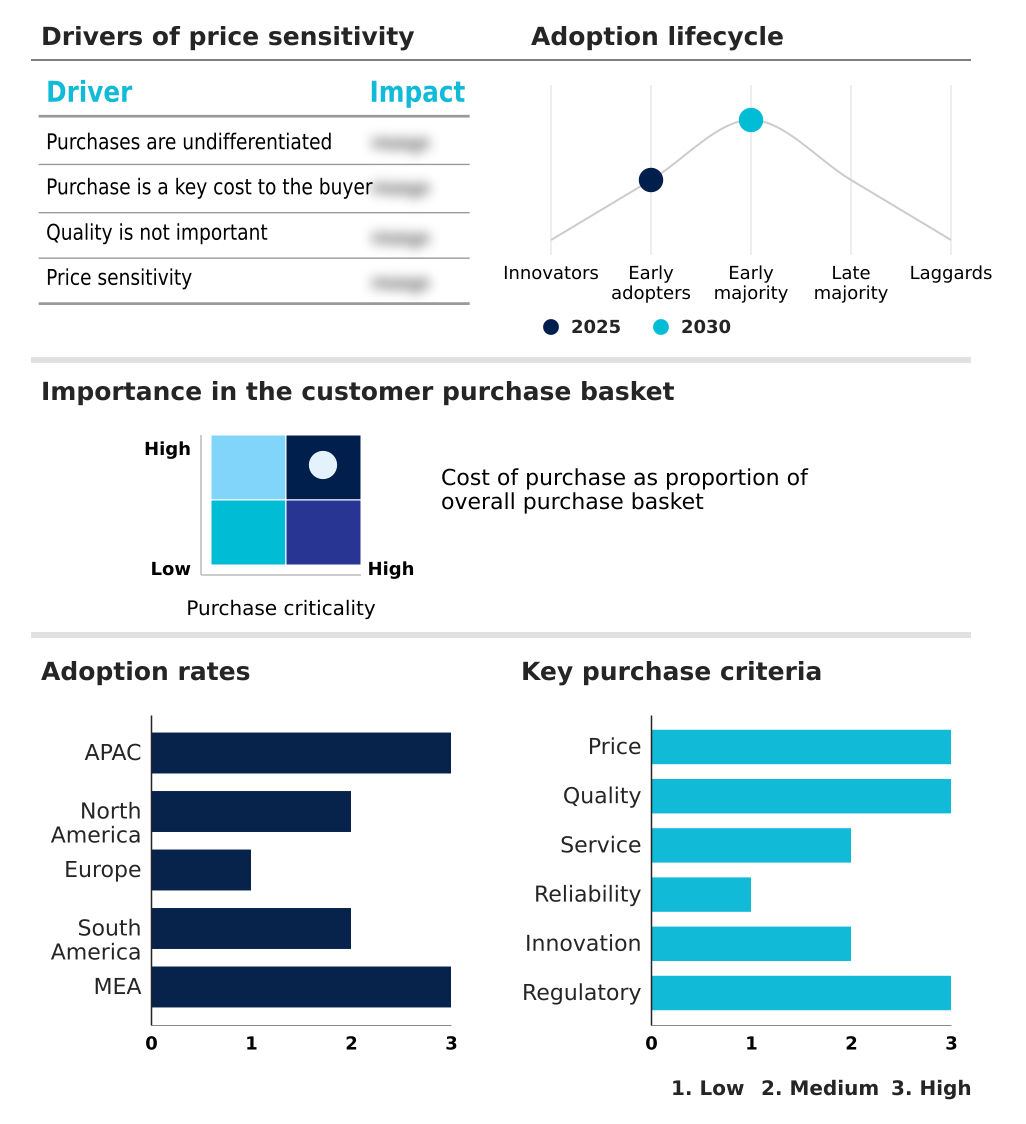
Customer Landscape of Amorphous Steels Industry
Competitive Landscape
Companies are implementing various strategies, such as strategic alliances, amorphous steels market forecast, partnerships, mergers and acquisitions, geographical expansion, and product/service launches, to enhance their presence in the industry.
Advanced Technology and Materials - The vendor provides specialized soft magnetic components, delivering advanced amorphous alloy ribbons, nanocrystalline materials, and engineered magnetic cores designed for high-efficiency power distribution and industrial manufacturing applications.
The industry research and growth report includes detailed analyses of the competitive landscape of the market and information about key companies, including:
- Advanced Technology and Materials
- AONA Technology Co. Ltd.
- Arnold Magnetic Tech.
- Bomatec AG
- China Amorphous Technology Co Ltd
- Gaotune Technologies Co. Ltd.
- Hitachi Ltd.
- Leimai Magnetic Materials Co Ltd
- Londerful New Material Technology
- Metglas Inc.
- Nanocrystalline Strip Technology
- Nippon Steel Corp.
- POSCO Co. Ltd.
- Proterial Ltd.
- TDK Corp.
- Toshiba Materials Co. Ltd.
- Transmart Industrial Ltd.
- Vacuumschmelze GmbH and Co. KG
- Vikarsh Nano Pvt. Ltd.
- Yeke Technology Co. Ltd.
Qualitative and quantitative analysis of companies has been conducted to help clients understand the wider business environment as well as the strengths and weaknesses of key industry players. Data is qualitatively analyzed to categorize companies as pure play, category-focused, industry-focused, and diversified; it is quantitatively analyzed to categorize companies as dominant, leading, strong, tentative, and weak.
Recent Development and News in Amorphous steels market
- In the Steel industry, the accelerated integration of advanced manufacturing technologies for high-permeability soft magnetic materials directly expanded the availability of specialized alloys, supporting increased Amorphous Steels demand for smart grid deployment projects requiring 30% lower transmission losses.
- Stringent electrical efficiency regulations targeting base-load power conversion forced transformer manufacturers to substitute standard silicon steel with high-performance non-crystalline alloys, impacting Amorphous Steels demand to meet new energy performance standards.
- The rapid expansion of artificial intelligence infrastructure mandated upgrades to high-density power delivery architectures, elevating Amorphous Steels consumption for hyperscale data center power components requiring 20% higher thermal efficiency.
- Automotive structural transitions toward lightweight and high-efficiency electric vehicle powertrains shifted material procurement toward advanced metallic glasses, driving Amorphous Steels integration within electric vehicle power conversion modules to reduce stator weight by 15%.
Dive into Technavio’s robust research methodology, blending expert interviews, extensive data synthesis, and validated models for unparalleled Amorphous Steels Market insights. See full methodology.
| Market Scope | |
|---|---|
| Page number | 303 |
| Base year | 2025 |
| Historic period | 2020-2024 |
| Forecast period | 2026-2030 |
| Growth momentum & CAGR | Accelerate at a CAGR of 5.2% |
| Market growth 2026-2030 | USD 200177.3 thousand |
| Market structure | Fragmented |
| YoY growth 2025-2026(%) | 4.6% |
| Key countries | China, Japan, India, South Korea, Australia, Indonesia, US, Canada, Mexico, Germany, France, UK, Italy, Spain, The Netherlands, Brazil, Argentina, Chile, Saudi Arabia, UAE, South Africa, Turkey and Egypt |
| Competitive landscape | Leading Companies, Market Positioning of Companies, Competitive Strategies, and Industry Risks |
Research Analyst Overview
- The Amorphous Steels Market is undergoing a fundamental transformation as industries prioritize energy conservation and high-frequency power optimization. By eliminating the crystalline grain lattice, advanced iron-based metallic glass eliminates magnetic domain wall pinning, drastically reducing energy dissipation during continuous magnetization cycles.
- Corporate boardrooms and utility planners are aligning their procurement strategies to mandate the use of soft magnetic alloy ribbons, achieving a 35% improvement in overall network transmission efficiency compared to standard legacy grid infrastructure.
- This strategic shift is further accelerated by engineering breakthroughs that deliver high saturation flux density in newer alloy formulations, allowing for the miniaturization of electrical components without sacrificing performance. Furthermore, the integration of bulk metallic glass components into industrial automation and aerospace applications ensures superior mechanical wear resistance and eddy current minimization.
- As regulatory frameworks tighten around energy performance, manufacturers are heavily prioritizing these advanced non-crystalline materials to secure long-term compliance, reduce lifecycle operational expenditures, and differentiate next-generation power electronics in an increasingly efficiency-driven industrial landscape.
What are the Key Data Covered in this Amorphous Steels Market Research and Growth Report?
-
What is the expected growth of the Amorphous Steels Market between 2026 and 2030?
-
USD 200.18 million, at a CAGR of 5.2%
-
-
What segmentation does the market report cover?
-
The report is segmented by Type (Amorphous ribbon, and Nano-crystalline ribbon), Application (Distribution transformer, Consumer electronics, Automotive, and Others), Product (Single-ply coil, Multiple-ply coil, and Processed cores) and Geography (APAC, North America, Europe, South America, Middle East and Africa)
-
-
Which regions are analyzed in the report?
-
APAC, North America, Europe, South America and Middle East and Africa
-
-
What are the key growth drivers and market challenges?
-
Global decarbonization mandates accelerating adoption of ultra low loss distribution transformer cores, High capital investment and production complexity of rapid solidification ribbon casting protocols
-
-
Who are the major players in the Amorphous Steels Market?
-
Advanced Technology and Materials, AONA Technology Co. Ltd., Arnold Magnetic Tech., Bomatec AG, China Amorphous Technology Co Ltd, Gaotune Technologies Co. Ltd., Hitachi Ltd., Leimai Magnetic Materials Co Ltd, Londerful New Material Technology, Metglas Inc., Nanocrystalline Strip Technology, Nippon Steel Corp., POSCO Co. Ltd., Proterial Ltd., TDK Corp., Toshiba Materials Co. Ltd., Transmart Industrial Ltd., Vacuumschmelze GmbH and Co. KG, Vikarsh Nano Pvt. Ltd. and Yeke Technology Co. Ltd.
-
Market Research Insights
- The Amorphous Steels Market is structurally evolving to meet the intense efficiency demands of modern power electronics and electrical grids. Manufacturers are increasingly integrating non-crystalline alloys to optimize thermal dissipation control in high-frequency applications. By mitigating magnetic core saturation, component designers have successfully improved the power usage effectiveness of advanced computing facilities by 18%.
- Furthermore, the incorporation of these low-loss magnetic materials into renewable energy inverter systems has increased overall power conversion efficiency by up to 25%, directly lowering operational lifecycle costs for utility providers. This systemic transition toward high-performance metallic glasses enables operators to achieve stringent regulatory compliance while maximizing the reliability and output of critical electrical infrastructure.
We can help! Our analysts can customize this amorphous steels market research report to meet your requirements.
 RIA -